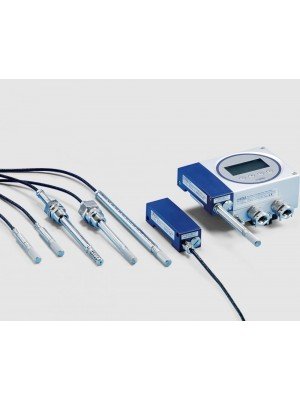
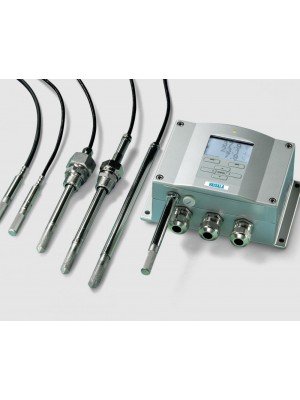
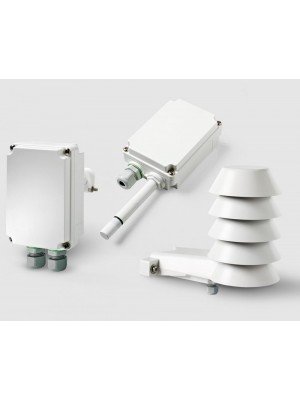
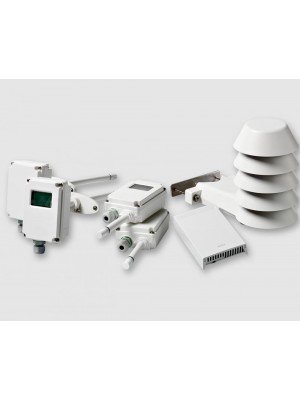
Seacom supplies humidity and temperature transmitters for HVAC, building automation, cleanrooms, laboratories and industrial processes. These instruments provide continuous measurements for controllers, building management systems and monitoring equipment.
Choose from wall-mounted, duct-mounted, outdoor and remote-probe designs. Depending on the model, available interfaces include 4–20 mA, voltage outputs, Modbus RTU and BACnet MS/TP. Select the instrument according to the installation conditions, required accuracy and control-system interface.
Choosing a Humidity Transmitter for HVAC
A humidity transmitter for HVAC should measure conditions at a location that represents the space or air stream being controlled. Room, duct and outdoor measurements serve different purposes and may require different probe arrangements and protective accessories.
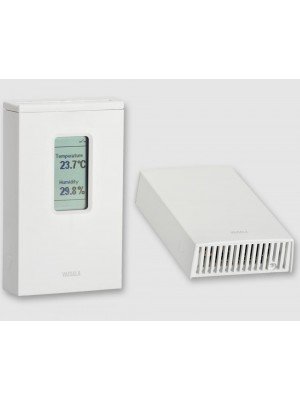
Room humidity: Wall-mounted transmitters measure conditions in occupied spaces, laboratories, storage rooms and controlled environments.
Duct humidity: Duct-mounted transmitters measure supply or return air in ventilation systems and air-handling units.
Outdoor humidity: Suitable outdoor models provide reference measurements for ventilation control. Consider protection from rain and solar heating.
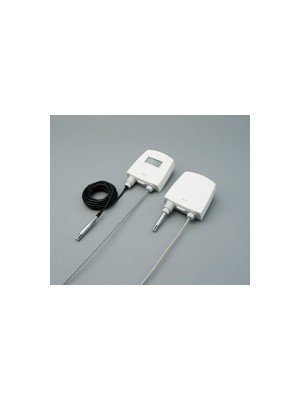
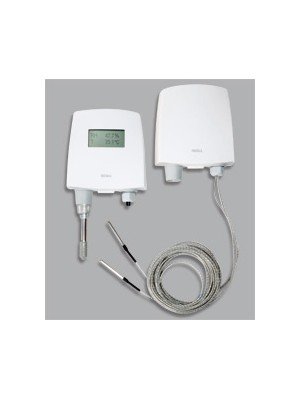
Remote measurement: Separate probes allow the sensing point to be positioned away from the transmitter display or electronics.
Consider a modular system with interchangeable probes. Confirm the probe, measurement parameters and controller interface.
The families above provide a starting point for HVAC selection. For environmental chambers, elevated temperatures, high humidity, pressurised processes or hazardous locations, review the specialised instruments below with Seacom before specifying a model.
Humidity Measurement for Cleanrooms and Laboratories
When selecting a humidity sensor for a cleanroom or laboratory, consider measurement accuracy, long-term stability, calibration access and the location of the sensing point. The instrument must also suit the cleaning procedures and environmental conditions at that location.
A transmitter connected to a BMS or PLC provides measurement for control and indication. Applications requiring recorded history, alarms and reporting may also need a separate monitoring system. Sensor selection alone does not establish compliance with pharmaceutical or quality-system requirements.
4–20 mA: A common industrial interface for controllers and data-acquisition systems. Confirm loop power, input compatibility and output scaling.
Voltage output: Common in HVAC control systems. Match the output range, power supply and wiring requirements to the controller.
Modbus RTU: Suitable for compatible RS-485 networks. Confirm the supported registers, communication settings and network wiring.
BACnet MS/TP: Available on selected instruments for compatible building-automation networks.
Not every model supports every interface. Specify the complete model configuration rather than relying on the product-family name alone.
What to Check Before Ordering
Measurement: Relative humidity only, humidity and temperature, or additional calculated parameters.
Operating conditions: Normal and maximum temperature, humidity, pressure and air velocity.
Accuracy: Required performance across the actual operating range, not only at a single reference condition.
Installation: Wall or duct mounting, probe length, insertion depth, cable length and access for servicing.
Environment: Condensation, dust, chemical exposure and required enclosure protection.
Integration: Power supply, analogue input type, digital protocol and measurement scaling.
Calibration: Certificate requirements, calibration points and arrangements for periodic checks.
Installation and Calibration Considerations
Position the sensor where airflow and conditions represent the intended measurement. Avoid local heat sources, stagnant pockets and direct water spray. Follow the selected manufacturer's guidance for mounting, orientation, wiring and environmental protection.
Plan access for inspection and calibration. The appropriate checking interval depends on the environment, required measurement confidence, instrument performance and the site's quality procedures.
Frequently Asked Questions
What is the difference between a humidity sensor and a transmitter?
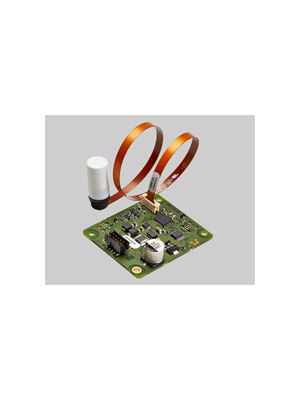
A humidity sensor is the sensing element. A humidity transmitter combines sensing and signal-processing functions to provide an output that a controller or monitoring system can use. Some probes also contain their own processing electronics and digital interface.
Can one instrument measure humidity and temperature?
Yes. Many transmitters measure both relative humidity and temperature. Selected models also provide calculated parameters such as dew point, wet-bulb temperature or enthalpy. Check the supported measurements and outputs for the chosen configuration.
Which humidity transmitter is suitable for HVAC?
Start with the measurement location: room, duct or outdoor air. Then compare accuracy, operating conditions, output interface and calibration requirements. Routine ventilation and critical controlled environments may require different instruments.
Can an HVAC humidity transmitter measure very dry compressed air?
Do not assume that a standard HVAC transmitter is suitable. Very dry compressed air requires an instrument selected for the dew-point range, process pressure and sampling arrangement. See the dew point meters and transmitters for this application.
Humidity Monitoring for Data Centres
Planning measurements for server rooms or air-handling systems? Explore sensor placement, relative humidity, dew point and monitoring-system requirements.
For a broader guide to room, duct and outdoor measurement, explore Vaisala HVAC sensors and transmitters, including selection considerations for building-automation systems.
Humidity Transmitter Selection and Technical Support
Seacom Process Instruments is based in Malaysia, with offices in Kuala Lumpur and Penang. Our team can assist with industrial humidity transmitter selection, probe configuration, mounting accessories and control-system compatibility.
Send us the installation location, operating temperature and humidity, required accuracy, output signal and power supply. Include any calibration or documentation requirements so we can recommend a suitable configuration.
The Vaisala HMT360 Series was an intrinsically safe transmitter platform for humidity, temperature and moisture measurement in hazardous areas. It is discontinued and replaced by the Vaisala HMT370EX with an application-specific probe.
The Vaisala HMT330 Series was a flagship industrial transmitter platform for humidity, temperature and calculated moisture parameters. It is discontinued and replaced by an Indigo500 transmitter with the HMP probe selected for the application.
HMT331 wall mounting → HMP1 with Indigo500
HMT333 ducts and tight spaces → HMP3 or HMP9 with Indigo500
HMT334 high pressure and vacuum → HMP4 with Indigo500
HMT335 high temperature → HMP5 with Indigo500
HMT337 high humidity → HMP7 with Indigo500
HMT338 pressurised pipelines → HMP8 with Indigo500
The Vaisala HMW90 Series provides high-accuracy humidity and temperature measurement for demanding indoor HVAC and controlled-environment applications.
Humidity accuracy up to ±1.7% RH
Analog or Modbus RTU output models
Optional display and configurable relay
Replaceable measurement module with calibration certificate
The Vaisala HMT120 and HMT130 provide accurate, stable humidity and temperature measurement for cleanrooms, laboratories, data centres and demanding HVAC applications.
Product transition: HMT120/HMT130 are expected to be phased out. For new projects, the Vaisala Origo10 is the recommended replacement platform.
The Vaisala PTU300 combined barometric pressure, relative humidity and temperature in one transmitter. The series is discontinued and has been replaced by a suitable Indigo520 barometric-pressure configuration with an application-specific HMP probe.
Legacy three-in-one pressure, humidity and temperature transmitter
PTU301, PTU303, PTU304, PTU305, PTU307 and PTU308 variants
Former applications include laboratories, meteorology and semiconductor measurement
Current replacement platform: Indigo520 with barometric-pressure measurement
Humidity probe selected according to mounting and process conditions
Existing wiring, outputs and process connections require migration review
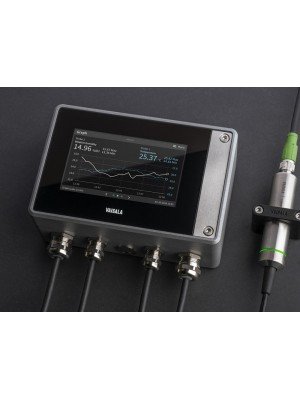
The Vaisala Indigo500 Series provides flagship industrial measurement integration: choose Indigo510 for a simplified single-probe system or Indigo520 for full dual-probe capability.
Indigo510: one probe and two isolated analog outputs
Indigo520: two probes, four isolated outputs and two relays
Ethernet web interface and Modbus TCP communication
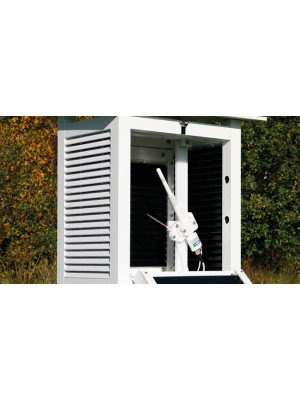
The Vaisala HMP155 provides stable humidity and temperature measurement for automatic weather stations, road-weather systems, airports, research sites and demanding outdoor monitoring.
Relative-humidity measurement from 0 to 100 %RH
Operating range from −80 to +60 °C
HMP155A with two analogue voltage outputs
HMP155D with RH voltage output and passive four-wire Pt100 temperature
HMP155E with RS-485 digital output
Optional warmed probe, chemical purge and additional temperature sensor
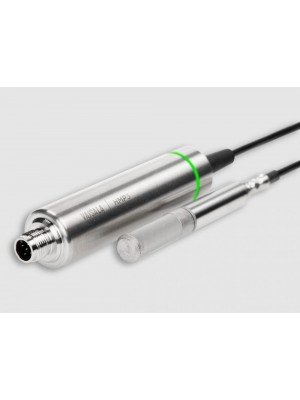
The Vaisala HMP3 is a high-accuracy, field-maintainable probe for industrial HVAC, air-handling units, cleanrooms, paint booths and environmental chambers.
Humidity accuracy up to ±0.8% RH
Temperature measurement from −40 to +120 °C
Field-replaceable filter and HUMICAP sensor option
Standalone Modbus RTU or Vaisala Indigo transmitter operation
This website uses cookies to ensure you get the best experience on our website