



.png)








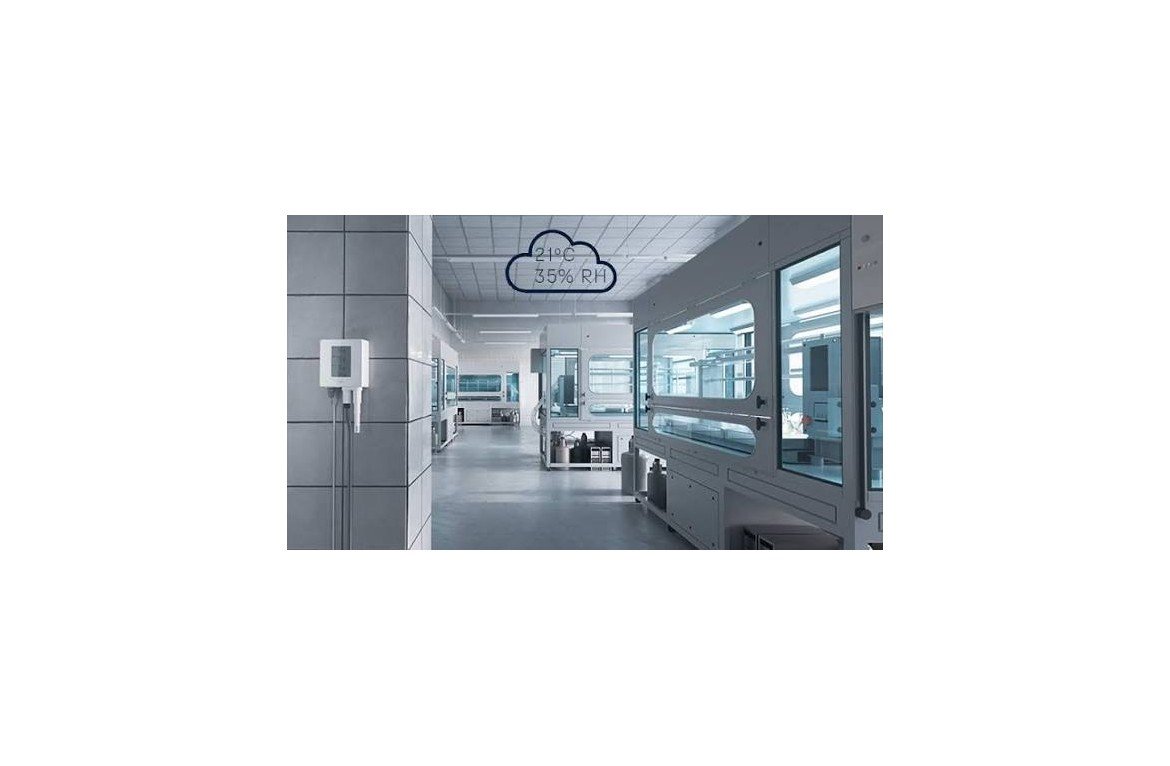
Pharmaceutical Cleanroom Monitoring: Sensors, Differential Pressure, CO₂, Dew Point & GxP CMS
Reliable Measurements. Records Your Quality Team Can Use.
A pharmaceutical facility needs much more than a temperature or humidity reading on a screen. Cleanrooms, production areas, laboratories, incubators, isolators, warehouses and controlled storage areas can require several different measurements to demonstrate that environmental conditions remain within their approved operating limits.
Depending on the application, these measurements may include relative humidity, temperature, differential pressure, dew point, carbon dioxide (CO₂), vaporized hydrogen peroxide (H₂O₂) and other process or environmental parameters. The measurements may also need to become part of a validated continuous monitoring system (CMS) with alarms, historical records, audit trails and controlled user access.
Seacom supports pharmaceutical and life-science facilities in selecting individual measurement instruments as well as complete Vaisala continuous monitoring solutions for regulated and critical environments.
Start With the Area and What Needs to Be Measured
A cleanroom, warehouse, laboratory, incubator and compressed-air system do not need the same instrument. Before selecting a sensor, first define the area, process and purpose of the measurement.
- Cleanrooms and production areas: Temperature, relative humidity and differential pressure are commonly important environmental parameters.
- Airlocks and pressure cascades: Differential pressure helps verify the intended airflow direction between controlled spaces.
- Air-handling systems: Humidity, temperature and differential pressure may be measured in supply air, return air, filters and HVAC equipment.
- Incubators and controlled atmospheres: CO₂, temperature and humidity may need to be monitored and controlled.
- Isolators and bio-decontamination: Vaporized hydrogen peroxide concentration, humidity and temperature can be important during H₂O₂ decontamination cycles.
- Dry air and compressed-air systems: Dew point measurement confirms how much moisture remains in the air or process gas.
- Warehouses and controlled storage: Temperature and humidity monitoring locations should normally be established against product requirements and temperature-mapping findings.
- Refrigerators and freezers: Temperature probes and data loggers must be suitable for the actual operating range.
Also establish whether each measurement is being used for process control, HVAC control, quality monitoring, alarm generation, regulatory records or temporary investigation. This affects the type of instrument, connectivity, calibration and documentation required.
1. Room and HVAC Measurement in Pharmaceutical Cleanrooms
Humidity and temperature measurements used for HVAC control should be taken at representative locations and with instruments suitable for the required accuracy, installation method and building-management interface.
The measurement used for HVAC control and the measurement used for an independent continuous monitoring system do not necessarily need to be the same device. In regulated facilities, separating control from independent monitoring can provide clearer records and greater confidence during investigations.
Vaisala HMP1 for High-Accuracy Probe Measurement
For applications requiring a compact high-accuracy humidity and temperature probe, the Vaisala HMP1 can be connected to a compatible Vaisala Indigo transmitter.
This arrangement is useful where the sensing point needs to be separated from the transmitter enclosure or where a probe-style installation is preferred.
Vaisala Origo10 for New Cleanroom and HVAC Installations
For new wall-mounted, duct-mounted or remote-probe HVAC installations, the Vaisala Origo10 Series provides a modern modular transmitter platform for cleanrooms, pharmaceutical facilities, laboratories and other controlled environments.
Rather than using one fixed sensing configuration, Origo10 can be combined with interchangeable probes according to the required measurement.
- Relative humidity and temperature for cleanrooms, laboratories and HVAC systems
- Temperature for room, duct and wider-range measurement
- CO₂ where indoor-air or ventilation monitoring is required
- Dew point for selected low-moisture applications
Origo10 is available with wall and duct mounting arrangements and can support analog outputs, Modbus RTU or BACnet MS/TP depending on the selected model and configuration.
For demanding cleanroom humidity and temperature measurement, Origo10 can be combined with a suitable Vaisala XMP10 Series probe . Selected XMP10 configurations provide humidity accuracy up to ±1% RH and temperature accuracy up to ±0.1 °C.
The interchangeable probe concept can also simplify maintenance. A factory-calibrated replacement probe can be fitted to a compatible Origo10 installation without replacing the complete transmitter.
What About Existing HMT120 and HMT130 Installations?
Existing pharmaceutical and cleanroom sites may already use Vaisala HMT120 or HMT130 humidity and temperature transmitters.
These instruments remain relevant for installed systems and like-for-like replacement requirements. However, for new projects or planned system upgrades, Origo10 should be considered as the current successor platform.
Vaisala HMD60 — Air-Handling and Duct Measurement
For critical supply-air and return-air ducts, the Vaisala HMD60 Series provides high-performance humidity and temperature measurement with analogue and digital integration options.
This makes HMD60 particularly useful where cleanroom conditions depend on accurate control of the air supplied by the HVAC system.
Explore Vaisala HMD60 duct transmitters →
2. Differential Pressure — Maintaining the Cleanroom Pressure Cascade
Humidity and temperature alone cannot show whether air is moving in the intended direction between cleanrooms, corridors and airlocks.
A pharmaceutical cleanroom may operate with a defined pressure relationship between adjacent areas. Measuring low differential pressure helps engineering and quality teams confirm that this pressure cascade remains within its specified limits.
A loss of differential pressure can indicate conditions such as an open door, HVAC problem, filter issue or change in airflow balance. For critical applications, the measurement may therefore need to be recorded and alarmed rather than simply displayed locally.
Vaisala PDT101 and PDT102 Differential Pressure Transmitters
The Vaisala PDT101 and PDT102 are designed to measure small pressure differences in cleanrooms and other critical environments.
Bidirectional models are particularly useful for monitoring room-to-room or room-to-corridor pressure relationships, while other configurations can be used for HVAC applications such as pressure drop across filters and fans.
The transmitters can also be incorporated into a Vaisala viewLinc monitoring system where differential-pressure records, alarms and reports are required.
Explore Vaisala PDT101 and PDT102 differential pressure transmitters →
3. Continuous Monitoring for GxP Environments
An individual transmitter provides a measurement. A continuous monitoring system adds another layer: historical data, alarms, user management, event records and reporting.
For pharmaceutical facilities, this distinction is important. When an environmental condition moves outside an approved limit, quality personnel may need to determine:
- Where did the excursion occur?
- When did it begin?
- How long did it last?
- How far did the measurement move outside the limit?
- Who received and acknowledged the alarm?
- Were any system settings changed?
- What records are available for investigation and review?
Vaisala viewLinc Continuous Monitoring System
The Vaisala viewLinc Continuous Monitoring System provides centralised monitoring, alarming and reporting for pharmaceutical, biotechnology, laboratory, cleanroom and controlled-storage applications.
A viewLinc system can bring together multiple measurement parameters rather than limiting the installation to temperature and humidity. Depending on the connected equipment, a system can monitor parameters including:
- Temperature
- Relative humidity
- Differential pressure
- Carbon dioxide
- Dew point
- Door contacts and Boolean inputs
- Signals from compatible transmitters and Modbus instruments
Explore Vaisala viewLinc Continuous Monitoring System →
Vaisala CAB100 Industrial Monitoring Cabinet
For installations involving multiple transmitters and monitoring points, Vaisala CAB100 can integrate measurement equipment into a preconfigured industrial monitoring cabinet.
This can be particularly useful for cleanrooms where several differential-pressure, humidity, temperature or other transmitter signals need to be incorporated into a viewLinc monitoring architecture.
Explore Vaisala continuous monitoring equipment →
4. Wired or Wireless Pharmaceutical Monitoring
The correct communications architecture depends on the facility. A new production area may have Ethernet available at every monitoring point, while an existing pharmaceutical plant may benefit from wireless monitoring where additional cabling would be disruptive.
Vaisala RFL100 and AP10 — VaiNet Wireless Monitoring
The Vaisala RFL100 data logger communicates through the AP10 Access Point using Vaisala VaiNet wireless technology. Configurations are available for temperature, humidity and CO₂ monitoring.
Wireless coverage, building construction, probe location and service access should be reviewed during system design rather than assuming that every monitoring point has the same radio conditions.
Explore Vaisala RFL100 and AP10 →
Vaisala VDL200 — PoE Wired Monitoring
Where Ethernet infrastructure is available, the Vaisala VDL200 provides a wired Power-over-Ethernet monitoring platform for connection to compatible Vaisala probes and viewLinc.
Different probe configurations allow VDL200 to be applied to temperature, humidity, CO₂ and other measurement requirements.
5. CO₂ Measurement for Incubators and Controlled Atmospheres
Not every pharmaceutical measurement is a room measurement. Cell-culture incubators, controlled-atmosphere equipment and other life-science processes may require percentage-level carbon dioxide measurement.
Vaisala GMP251 CO₂ Probe
The Vaisala GMP251 is designed for percentage-level CO₂ measurement in demanding applications such as life-science incubators.
The probe includes compensation functions for environmental influences and can operate as a standalone measurement probe or form part of a Vaisala Indigo measurement system.
For a pharmaceutical facility containing both cleanrooms and incubators, this allows the overall measurement strategy to extend beyond conventional room temperature and humidity.
Explore Vaisala GMP251 CO₂ probe →
6. Vaporized Hydrogen Peroxide Measurement for Bio-Decontamination
Vaporized hydrogen peroxide is widely used for bio-decontamination in isolators, material-transfer hatches and other controlled environments.
During these processes, measuring only conventional room humidity may not provide the information needed to understand the H₂O₂ decontamination cycle.
Vaisala HPP270 Series
The Vaisala HPP270 Series is designed specifically for vaporized hydrogen peroxide measurement.
The HPP271 measures vaporized H₂O₂ concentration, while the HPP272 can additionally provide parameters including humidity and temperature-related measurements. The probes are designed for applications such as isolator, transfer-hatch and room bio-decontamination.
HPP270 probes can also be used with compatible Vaisala Indigo transmitters, allowing H₂O₂ measurement to be incorporated into a larger process measurement architecture.
Explore Vaisala HPP270 and gas measurement instruments →
7. Dew Point Measurement for Dry Air and Pharmaceutical Utilities
Relative humidity is usually the familiar measurement for cleanroom ambient conditions, but dew point becomes particularly important in very dry environments, compressed air, process gases and drying systems.
Compressed air is widely used in industrial and pharmaceutical facilities. Where the moisture content of the air matters, dew point provides a more useful indication of dryness than ambient relative humidity.
Vaisala DMP8 Dew Point Probe
The Vaisala DMP8 is designed for dew point measurement in pressurised pipelines and is suitable for compressed air and industrial gas applications.
Its adjustable installation arrangement allows the measurement point to be positioned inside the process, while an optional ball-valve installation can simplify probe insertion and removal in pressurised systems.
Explore Vaisala DMP8 dew point probe →
8. Multi-Parameter Measurement With Vaisala Indigo
Pharmaceutical applications increasingly require several measurement technologies within one facility. Instead of treating every probe as a completely separate instrument, the Vaisala Indigo platform provides a common transmitter family for compatible smart probes.
Vaisala Indigo510 and Indigo520
The Indigo510 and Indigo520 can be combined with compatible Vaisala probes for measurements including humidity, temperature, dew point, CO₂ and vaporized H₂O₂.
Indigo520 can connect two compatible probes simultaneously, making it useful where two measurement parameters need to be displayed, transmitted or integrated into the same control architecture.
Available integration features include analogue outputs, Ethernet connectivity, Modbus TCP and configurable relay functions depending on the selected transmitter.
Explore Vaisala Indigo510 and Indigo520 →
What Does 21 CFR Part 11 Mean for a Monitoring System?
21 CFR Part 11 addresses electronic records and electronic signatures. It can become relevant when environmental monitoring records are maintained electronically to satisfy applicable FDA recordkeeping requirements.
It does not mean that every sensor installed inside a pharmaceutical building automatically falls under Part 11. The facility's quality team should determine which records are regulated, how those records are used and which system functions are required.
When assessing a continuous monitoring system for a Part 11 application, important controls normally include:
- Authorised access: Individual user accounts and appropriate permissions.
- Audit trails: Secure, time-stamped records of relevant actions and changes.
- Record protection: Arrangements for retaining and retrieving required records.
- Record copies: Accurate and complete records suitable for review.
- Validation: Documented evidence that the configured system performs its intended functions.
- Procedures and training: Defined responsibilities for operating and maintaining the system.
A monitoring system can provide technical functions that support a regulated application, but software alone does not make a facility compliant. Configuration, qualification, procedures, training, maintenance and ongoing quality-system control remain important.
Alarms, Historical Records and Investigations
Environmental monitoring becomes particularly valuable when something goes wrong. Configured alarm thresholds and delays should notify the appropriate personnel without creating an excessive number of nuisance alarms.
Historical trends can then help determine when an excursion started, its duration and how conditions recovered. Alarm records and audit information can support the subsequent investigation.
For example, if a pharmaceutical storage room rises above its approved temperature limit, the monitoring system can provide the measurement history and associated alarm information. The quality team can then use those records together with its approved procedures to assess the affected product.
The monitoring record supports the decision; it does not itself determine product disposition.
Sensor Placement and Calibration Still Matter
A sophisticated monitoring database cannot compensate for a poorly selected measurement point. Permanent sensor locations should be justified against the process, room layout, airflow, risk assessment and relevant mapping studies.
Calibration points should also reflect the conditions in which the instrument actually operates. Where a transmitter sends an analogue or digital signal to another system, consider the complete measurement chain rather than only the sensing element.
Calibration intervals, alarm limits and maintenance requirements should be controlled under the facility's quality system and based on the criticality of the measurement.
Planning a Pharmaceutical Monitoring System
Before requesting a monitoring system or individual sensors, prepare the basic application information for each measurement point:
- Area, room or equipment being monitored
- Parameter to be measured
- Expected measurement range
- Required accuracy
- Normal and alarm limits
- Number of monitoring points
- Wired, PoE or wireless connectivity preference
- Required BMS, PLC, SCADA or CMS integration
- Calibration requirements
- GxP documentation requirements
- IQ/OQ or validation requirements
- 21 CFR Part 11 or EU GMP Annex 11 considerations where applicable
Starting with the measurement requirement rather than a particular model normally produces a more effective system.
More Than Humidity and Temperature
A pharmaceutical facility may contain cleanrooms, airlocks, laboratories, incubators, isolators, cold rooms, warehouses, compressed-air systems and production equipment. Trying to use one measurement technology for every application can lead to unnecessary compromises.
A more practical approach is to select the correct measurement for each area and then decide how those measurements should be integrated into the facility's control and monitoring systems.
Seacom can assist with Vaisala solutions for humidity, temperature, differential pressure, dew point, CO₂, vaporized H₂O₂ and continuous environmental monitoring, including individual transmitters, data loggers, Vaisala Indigo smart-probe systems and viewLinc CMS.
Ask Seacom About Your Pharmaceutical Measurement Application
Send us the area or equipment to be monitored, measurement parameters, required ranges, approximate number of monitoring points and preferred connectivity.
If the project includes GxP, IQ/OQ, system validation, 21 CFR Part 11, EU GMP Annex 11 or specific calibration requirements, include these during the initial discussion so the complete scope can be reviewed with your engineering and quality teams.
Discuss your pharmaceutical monitoring application on WhatsApp →
All comments