



.png)







Modular Spot Checking for Industrial Measurements
One handheld indicator, different measurement tasks
Portable measurements are often needed in places where a permanent transmitter is unavailable, difficult to access or due for a performance check. A modular handheld system allows the technician to connect the probe required for the job instead of carrying a separate meter for every parameter.
The Vaisala Indigo80 Handheld Indicator supports portable spot checking, data logging, diagnostics and field calibration with a wide range of compatible probes. Two devices can be connected simultaneously, making direct comparison and environmental compensation more practical.
Typical measurements include relative humidity, temperature, dew point, carbon dioxide, moisture in oil and vaporised hydrogen peroxide.
What is industrial spot checking?
A spot check is a portable measurement taken at a selected location and time. It can answer a specific question: Is this room uniform? Is the compressed air dry at the point of use? Does an incubator recover after its door is opened? Is an online transmitter indicating a believable value?
One reading may be enough for a quick check, but short-term logging often provides more useful evidence. A trend shows stabilisation, cycling, recovery and intermittent excursions that can be missed by a single displayed value.
- Commissioning a new room, chamber, dryer or process measurement
- Comparing several locations to identify gradients or problem areas
- Investigating an alarm, customer complaint or product-quality issue
- Checking a fixed transmitter before deciding whether it needs calibration
- Recording conditions during maintenance, validation or process trials
- Providing temporary measurement while a fixed instrument is being serviced
Spot check, field verification or calibration?
| Activity | Purpose | Typical outcome |
|---|---|---|
| Spot check | Observe the condition at a selected place and time. | A reading or short trend used for troubleshooting, inspection or process understanding |
| Field verification | Compare an installed instrument with a suitable reference under the same stable conditions. | Evidence that the installed reading is acceptable or requires further investigation |
| Calibration | Compare an instrument against a traceable reference using a defined procedure and documented conditions. | Calibration results showing the measurement error at specified points |
| Adjustment | Change the instrument response to reduce an identified measurement error. | A modified instrument that should be verified or calibrated again after adjustment |
A close comparison is not automatically a calibration
For a defensible field calibration, use a suitable reference, allow both instruments to stabilise in the same conditions, document the method and results, and follow the applicable quality procedure. Do not adjust an instrument merely because two unstabilised readings differ.
Why a modular handheld system is useful
- Interchangeable measurement probes: Use the probe suited to the parameter, range and application.
- Two simultaneous inputs: Compare a reference and installed probe or measure two related parameters together.
- Graphical trends: Watch the reading stabilise and identify cycles or short excursions.
- Data logging: Record measurements for later review, reporting and comparison.
- Probe diagnostics and configuration: Review device status and supported settings without removing the probe to a workshop.
- Field calibration support: Carry out guided or manual procedures where the connected device supports them.
- Portable professional construction: Move one indicator between rooms, machines and measurement points.

Application example. A portable reference can be taken to the installed instrument so both devices experience the same environment during a field comparison.
Choose the probe for the measurement
| Parameter | Probe or product starting point | Typical spot-checking application |
|---|---|---|
| Humidity and temperature | Indigo80 with HMP80 | Rooms, chambers, warehouses, HVAC, incubators and comparison with installed humidity transmitters |
| Dew point | Indigo80 with DMP80 | Compressed air, industrial gases, dryers, sampling points and low-humidity processes |
| Carbon dioxide | Indigo80 with GMP80P | CO₂ incubators and pump-aspirated sampling where the probe cannot be placed directly at the measurement point |
| Industrial CO₂ | Vaisala GMP251 or GMP252 | High-percentage CO₂ or ppm-level measurements, depending on the selected probe |
| Temperature | Vaisala TMP1 | Accurate industrial temperature measurement and comparison with compatible installed probes |
| Moisture in oil | Vaisala MMP8 | Transformer, hydraulic, lubrication and other compatible industrial oils |
| Vaporised hydrogen peroxide | Vaisala HPP270 Series | Bio-decontamination process checks involving H₂O₂ concentration, humidity and temperature |
Two probes can answer a better question
Connecting two compatible devices is useful when the relationship between measurements matters more than either value alone.
- Reference and installed probe: View both readings together during a field comparison.
- Room and chamber: Compare the surrounding condition with the controlled space.
- Dryer inlet and outlet: Observe how the process changes moisture conditions.
- Temperature compensation: Use a compatible temperature measurement as an environmental compensation input where supported.
- Before and after maintenance: Log repeatable measurement points using the same indicator and procedure.
Compatibility and available calibration functions depend on the connected probe model and firmware version. Confirm the complete indicator, cable and probe configuration before planning a field procedure.
A practical field-comparison procedure
- Define the purpose: Decide whether the task is a spot check, verification, calibration or adjustment.
- Select a suitable reference: Its range, uncertainty and calibration status must be appropriate for the installed instrument.
- Place the probes together: Keep them close enough to experience the same condition without one probe disturbing the other.
- Allow stabilisation: Watch the trend rather than recording the first displayed value.
- Compare at useful points: One normal operating point may support a quick verification; a formal calibration may require several defined points.
- Record the conditions: Note temperature, pressure, flow, reference identity, instrument serial number, time and procedure.
- Assess before adjusting: Consider combined uncertainty and acceptance limits. Investigate installation effects before changing the instrument.
- Verify after adjustment: Repeat the comparison and preserve both the before- and after-adjustment results.
Humidity and temperature spot checking
Humidity comparisons are sensitive to small temperature differences. Place the reference close to the installed sensor, avoid touching the sensing head, and allow both devices to reach the same stable condition.
Heat from a hand, lamp, wall, open door or nearby process can create a local temperature difference large enough to produce different relative-humidity readings even when both sensors are working correctly. In chambers and rooms, log long enough to see control cycling and spatial variation.
The Vaisala HMK15 Humidity Calibrator can provide defined salt-reference conditions for suitable humidity calibration work, while Indigo80 with HMP80 provides the portable display and guided workflow.
Dew-point spot checking
Very dry gas measurement is especially sensitive to ambient leakage, wet tubing, unsuitable materials and insufficient stabilisation time. A poor sampling arrangement can make a healthy dryer appear faulty.
- Confirm whether the required value is pressure dew point or atmospheric dew point.
- Use short, clean and leak-tight sample tubing suitable for low-moisture measurement.
- Avoid dead-end pipe branches with no representative gas flow.
- Protect the probe from liquid water, excessive oil and particles.
- Record sampling pressure and flow so later readings can be compared properly.
- Allow the sensor and opened sampling system enough time to dry down.
CO₂ spot checking in incubators
Incubator CO₂ verification requires representative sampling without causing a large disturbance to the chamber. Opening the door changes CO₂, temperature and humidity, so the measurement method and recovery time should be consistent.
A pump-aspirated probe allows gas to be drawn through suitable tubing from the chamber or sampling port. Check the tubing material, sample flow, condensation risk and whether the reading has stabilised before comparing it with the incubator display.

Application example. Portable CO₂ measurement allows a technician to compare several incubators and investigate an installed indication.
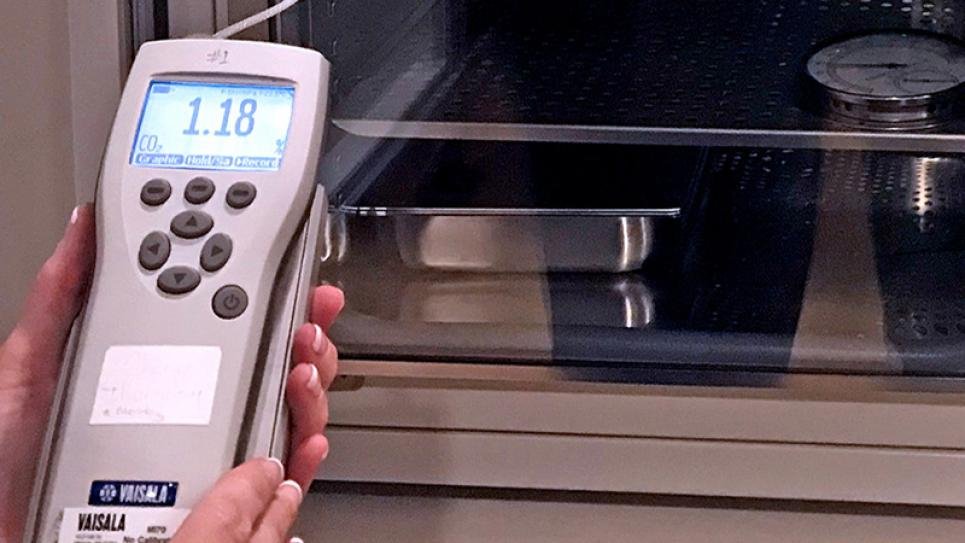
Application example. Sampling through a purpose-made port reduces the disturbance caused by opening the incubator door.
What the original handheld meters have become
The earlier article featured the HM70, DM70, GM70 and MM70 handheld meters. These models are discontinued and should not be presented as new-project recommendations.
| Legacy handheld | Measurement | Current direction |
|---|---|---|
| Vaisala HM70 | Humidity and temperature | Indigo80 with HMP80 |
| Vaisala DM70 | Dew point | Indigo80 with DMP80 |
| Vaisala GM70 | Carbon dioxide | Indigo80 with GMP80P |
| Vaisala MM70 | Moisture in oil | Indigo80 with MMP8 |
The Vaisala HM40 remains a straightforward dedicated handheld option for general humidity and temperature spot checks where a modular multi-parameter platform is not required.
Plan the handheld system as a complete kit
Selecting the indicator is only the first step. A practical field kit may also require the correct probe, connection cable, probe handle, sampling cell, tubing, pressure accessories, carrying case and reference equipment.
- Parameter and required measurement range
- Normal and maximum temperature and pressure
- Direct probe insertion or pump-aspirated sampling
- Number of probes that need to be connected together
- Required logging duration and reporting method
- Whether the task includes verification, calibration or adjustment
- Required cables, sample cells, tubing, handles and carrying case
- Probe and transmitter firmware compatibility
Portable measurement and field-calibration support in Malaysia
Seacom Process Instruments supplies and supports Vaisala portable measurement systems throughout Malaysia. Our team can help configure an Indigo80 kit for humidity, temperature, dew point, CO₂, moisture in oil, vaporised hydrogen peroxide and compatible fixed-instrument checks.
Send us the parameters, expected ranges, application, measurement pressure and temperature, installed instrument models, required logging time and whether you need spot checking, field verification or calibration support. We can then recommend the suitable probes, cables and accessories.