


.png)








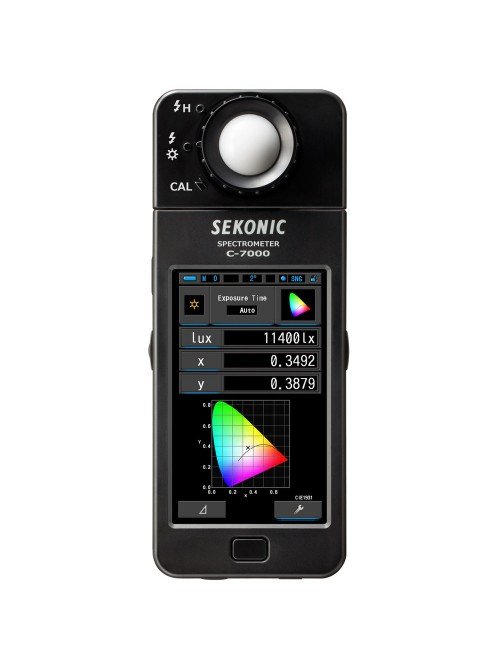
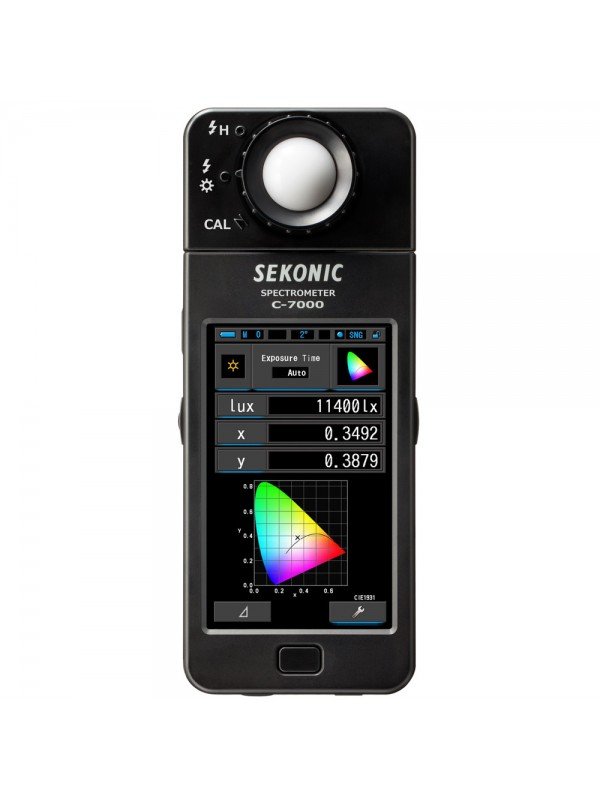
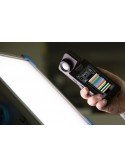
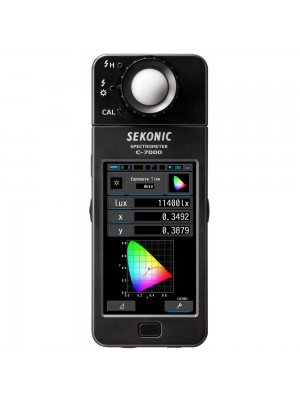
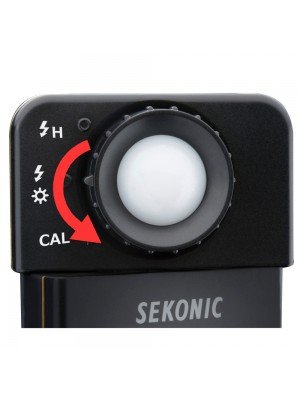
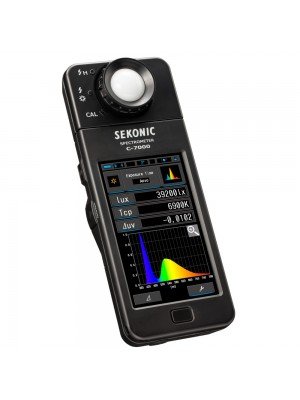
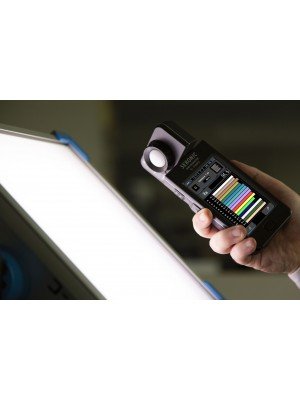
The Sekonic SPECTROMASTER C-7000 is a portable spectrometer for evaluating LED, fluorescent, HMI, tungsten, natural and flash light in industrial, laboratory and quality-control applications.
The Sekonic C-7000 is designed for engineers, lighting manufacturers, laboratories and quality teams that need to understand more than brightness alone. It measures the spectral composition of a light source and calculates the colour, rendering and photometric values used to evaluate lighting performance.
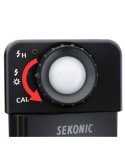
Its handheld design, 270-degree swivel head and 4.3-inch colour touchscreen allow measurements to be made directly at a luminaire, workstation, production line, greenhouse, studio or test location. Stored readings can be transferred to the C-7000 Utility for comparison, graphical review and CSV export.
| Measurement | What it indicates | Typical use |
|---|---|---|
| Illuminance | The quantity of light reaching the measurement plane, displayed in lux or foot-candles | Workplaces, laboratories, production areas, inspection stations and lighting verification |
| Spectral power distribution | How optical energy is distributed across wavelengths from 380 to 780 nm | LED development, incoming inspection, source comparison and quality control |
| Correlated colour temperature, Tcp | Whether nominally white light appears warmer or cooler | Luminaire matching and lighting specification |
| Deviation from Planckian locus, Δuv | The green-to-magenta shift that colour temperature alone cannot describe | Checking tint consistency between light sources |
| CRI, Ra and R1 to R15 | Traditional colour-rendering performance, including individual test colours | General lighting evaluation and comparison with established specifications |
| TM-30-18, Rf and Rg | Colour fidelity and average gamut change using a broader set of colour samples | Detailed architectural, retail and professional lighting evaluation |
| SSI | Spectral similarity between a measured source and a selected reference or another source | Film, television and multi-source lighting comparison |
| TLCI and TLMF | Expected colour performance for television cameras and matching between luminaires | Broadcast, video production and studio-lighting assessment |
| PPFD | Photosynthetic photon flux density within the photosynthetically active radiation region | Horticultural lighting, greenhouses and plant-growth research |
| Chromaticity coordinates | The measured colour location in CIE 1931, CIE 1964 or CIE 1976 systems | Colour specification, binning and source comparison |
| Dominant and peak wavelength | Characteristic wavelengths of coloured or narrow-band sources | LED inspection and technical light-source analysis |
| Specification | Sekonic C-7000 |
|---|---|
| Spectral sensor | CMOS linear image sensor |
| Spectral wavelength range | 380 to 780 nm |
| Ambient illuminance range | 1 to 200,000 lx; 0.1 to 18,600 fc |
| Flash-light range | 20 to 20,500 lx·s; 1.86 to 1,900 fc·s |
| Ambient colour-temperature range | 1,563 to 100,000 K |
| Flash colour-temperature range | 2,500 to 100,000 K |
| Viewing angle selection | 2° or 10° |
| Measurement operation | Single or continuous measurement |
| Internal memory | Up to 999 measurements |
| Display | 4.3-inch colour touchscreen LCD |
| Light receptor | 270-degree swivel head |
| Data output | Stored values, graphics and spectral irradiance in 1 nm or 5 nm increments through the C-7000 Utility |
| Power | Two AA batteries or USB bus power |
| Operating temperature | −10 to +40 °C |
| Dimensions | Approximately 183 × 73 × 27 mm |
| Weight | Approximately 230 g |
Measurement selection matters: colour temperature and CRI alone do not fully describe an LED source. Include Δuv when tint is important, TM-30 when fidelity and gamut matter, SSI for spectral source matching, and PPFD when evaluating plant-lighting intensity.
| Application | Measurements to prioritise | Practical purpose |
|---|---|---|
| LED manufacturing and incoming inspection | Spectrum, Tcp, Δuv, chromaticity, peak wavelength and CRI or TM-30 | Compare production output with approved samples and acceptance limits |
| Workplace and industrial lighting | Illuminance, Tcp, Δuv and CRI | Verify brightness, colour appearance and rendering performance at the work plane |
| Retail, museums and architectural lighting | Illuminance, TM-30, CRI and spectrum | Assess how lighting presents products, artwork and interior finishes |
| Broadcast and video production | SSI, TLCI, TLMF, Tcp and Δuv | Match sources and anticipate camera colour performance |
| Horticulture and plant-growth lighting | PPFD and spectrum | Evaluate photon delivery and spectral distribution for plant response |
| Medical, laboratory and inspection lighting | Illuminance, spectrum, colour coordinates and rendering indices | Document source performance for the defined technical or quality requirement |
| Flash and pulsed lighting | Flash illuminance, spectrum, Tcp and rendering indices | Characterise electronic flash using corded or cordless measurement |
| Metric | Main question answered | Important limitation |
|---|---|---|
| CRI | How faithfully does the source render established test colours compared with a reference? | The average Ra value can hide poor performance for particular colours, so review R1 to R15 where relevant |
| TM-30 Rf | How accurately are colours rendered across a larger sample set? | Fidelity alone does not show whether colour saturation increases or decreases |
| TM-30 Rg | How does the average colour gamut expand or contract? | Review Rf, Rg and the graphical result together rather than using one number alone |
| SSI | How closely does one spectral distribution resemble a defined reference or another source? | It measures spectral similarity and should not be interpreted as a general brightness rating |
| TLCI | How is the source expected to reproduce colour through a television-camera system? | It is intended for camera applications rather than general visual colour-rendering assessment |
Spectrum mode displays the measured energy across the visible wavelength range, helping users identify LED peaks, missing spectral regions and differences between nominally similar sources. Spectrum Comparison mode allows a measured source to be assessed against a stored reference.
Comparison modes are useful for incoming inspection and maintenance. A known acceptable luminaire can be stored as the reference, after which replacement lamps or production samples can be checked under the same measurement geometry and operating conditions.
Software compatibility: use the utility and firmware intended for the C-7000. Do not connect a different Sekonic meter to the C-700/C-7000 Utility unless the manufacturer specifically confirms compatibility.
| Requirement | Standard lux meter | Sekonic C-7000 |
|---|---|---|
| Illuminance measurement | Suitable when only lux or foot-candles are required | Measures illuminance together with spectral and colour information |
| Colour temperature and tint | Usually unavailable | Measures Tcp and Δuv |
| Colour-rendering evaluation | Unavailable | CRI, TM-30, SSI, TLCI and TLMF |
| Spectral graph | Unavailable | Displays and exports the 380 to 780 nm spectrum |
| Plant-lighting measurement | Lux does not represent photon flux for photosynthesis | Provides PPFD measurement |
| Best fit | Routine brightness surveys | Lighting development, diagnosis, comparison and technical quality control |
Measurement confidence depends on more than the meter specification. Establish a calibration interval based on usage, handling, required uncertainty and the quality system. Protect the optical receptor from dirt, impact and moisture, and verify the instrument after any event that may affect performance.
For repeatable quality-control work, define the measurement geometry, source warm-up period, dimming setting, acceptance parameters and allowable tolerances in a written procedure. Record as-found calibration results and retain measurement files with the inspected product or batch.
Seacom Process Instruments supplies the Sekonic C-7000 industrial spectrometer for lighting manufacturers, laboratories, production facilities, horticultural-lighting projects, medical environments, universities and technical inspection teams.
Our team can help confirm whether your application requires illuminance, spectral distribution, CRI, TM-30, SSI, TLCI, chromaticity or PPFD measurement and advise on a practical measurement and reporting approach.
Need to confirm whether the C-7000 fits your application? Send us the light-source type, expected illuminance, required colour metrics, measurement environment, data-export needs and destination country.
Download |

.

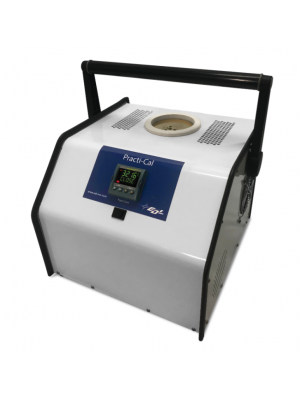
The EDL Practi-Cal Series provides dry-well and surface testing facilities for compatible temperature probes.

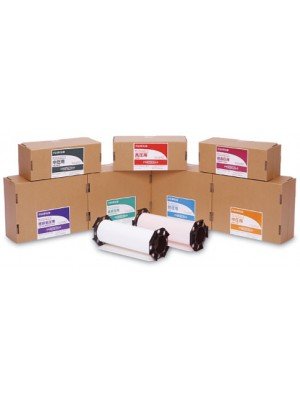
FUJIFILM Prescale reveals contact pressure and pressure distribution through changes in red colour density. Place the film between contacting surfaces to identify uneven loading and compare contact patterns.

The Vaisala PTB330 provides accurate, stable barometric-pressure measurement for professional meteorology, aviation, maritime systems, laboratories and demanding environmental applications.
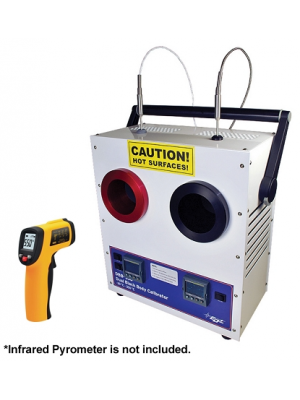
The EDL DBB Series combines hot and cold black body targets for checking compatible infrared thermometers and pyrometers.

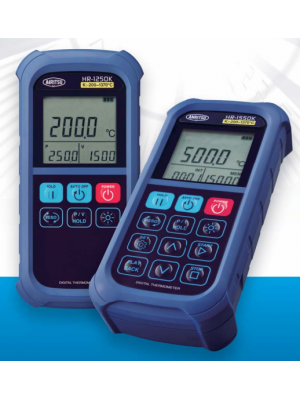
The Anritsu HR Series combines accurate Type K or Type E thermocouple measurement with a large display and an extensive choice of probes for surfaces, moving objects, liquids, air, food and specialised applications.
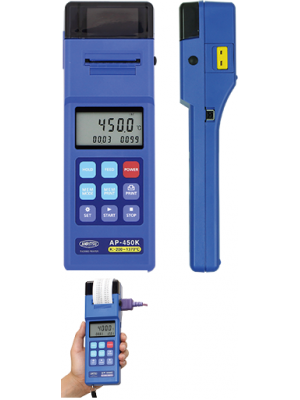
The Anritsu AP-400 Series combines a high-accuracy thermocouple thermometer with a built-in thermal printer. Measurements can be printed immediately, printed automatically at selected intervals or stored and printed later.
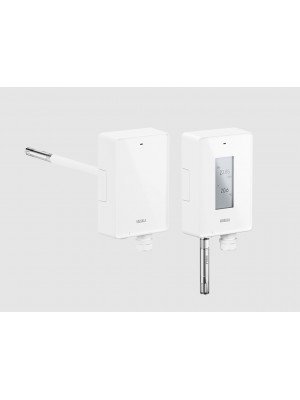
The Vaisala Origo10 Series comprises modular HVAC transmitters with interchangeable probes for humidity, temperature, CO2 and dew-point measurement.
Available with analog, Modbus RTU and BACnet MS/TP outputs, wall or duct mounting, an optional display and an IP65-rated enclosure.
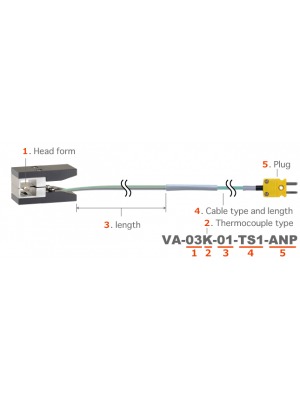
The Anritsu VA Series uses a clip-type sensing arrangement to measure heat-pipe surface temperature. Select the probe to suit the pipe dimensions and connected instrument.
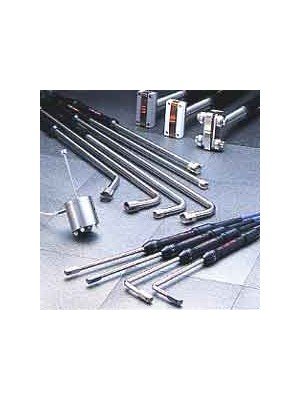
The Anritsu S Series includes surface temperature probes for different measurement tasks. Select the family according to the contact area, surface movement and probe support required.
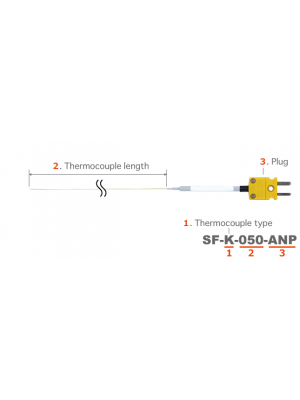
Anritsu SF Series fine flexible temperature probes use extra-fine thermocouple wire in a Teflon-coated sheath for internal temperature measurement.
The Vaisala DRYCAP® Dew Point and Temperature Probe DMP8 provides reliable low-humidity measurement in pressurised pipelines with adjustable installation depth.

The Hyoda ES-UT is a liquid-filled temperature instrument with a remote sensing bulb and microswitch contacts.
The Sekonic SPECTROMASTER C-7000 is a portable spectrometer for evaluating LED, fluorescent, HMI, tungsten, natural and flash light in industrial, laboratory and quality-control applications.
 C-7000 Catalogue
(1.76M)
C-7000 Catalogue
(1.76M)