



.png)






What Is Dew Point? A Practical Measurement Guide
Dew point tells you when moisture will condense
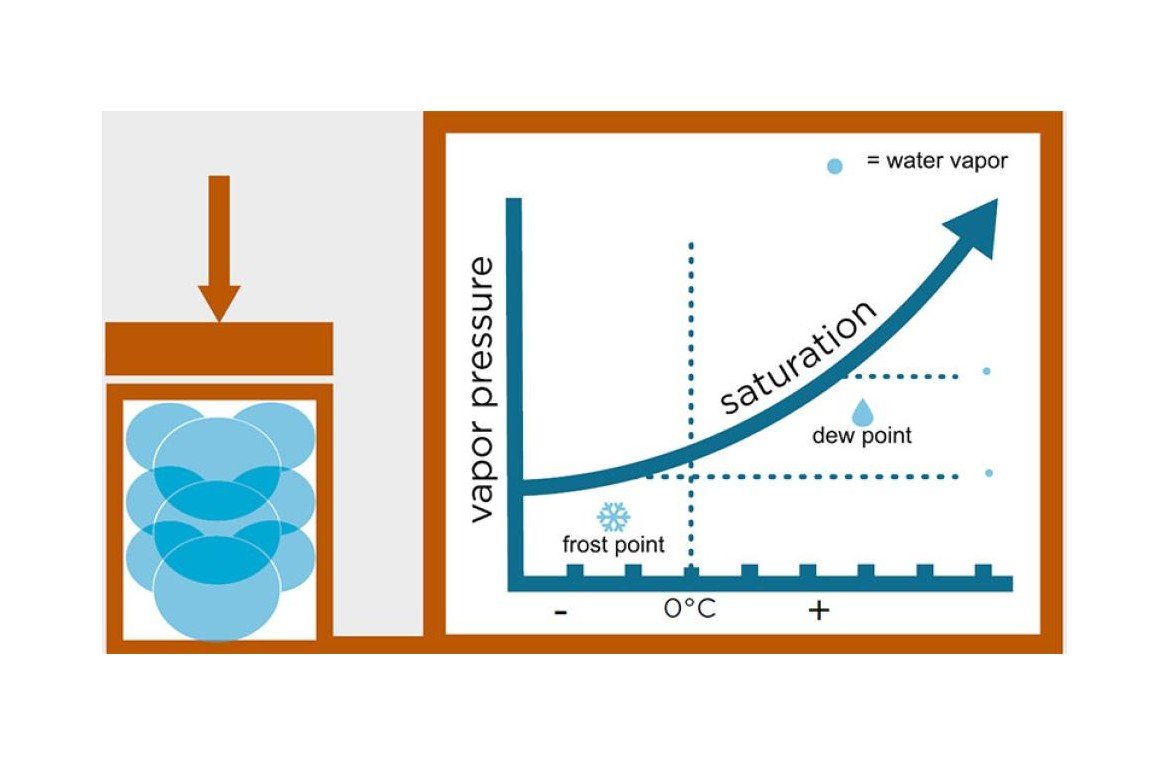
Dew point is the temperature at which water vapour in a gas begins to condense into liquid water. Below 0 °C, the equivalent value is often reported as frost point because water vapour may deposit as ice rather than liquid dew.
The practical rule is simple: if a surface or compressed-air pipe becomes colder than the gas dew point, condensation can form. A lower dew point therefore indicates a drier gas at the stated pressure.
Dew-point measurement is widely used for compressed air, industrial gases, refrigerant and desiccant dryers, dry rooms, battery manufacturing, semiconductor processes, plastics drying and other moisture-sensitive applications.
What physically happens at the dew point?
Water vapour creates a partial pressure within air or another gas. The maximum water-vapour pressure that can exist without condensation depends strongly on temperature. As the gas cools, its saturation vapour pressure falls.
When the gas temperature reaches the point where the actual water-vapour pressure equals the saturation vapour pressure, the gas is saturated. Further cooling causes some water vapour to condense. That temperature is the dew point.
A lower dew point means less water vapour
At the same pressure, gas with a dew point of −40 °C contains substantially less water vapour than gas with a dew point of +3 °C. The lower value represents the drier condition.
Dew point and relative humidity are not the same
Relative humidity describes how close the water-vapour pressure is to saturation at the current temperature. If air is heated without adding or removing moisture, its relative humidity falls. If the same air is cooled, its relative humidity rises.
Dew point is more directly connected to the actual amount of water vapour present. If the moisture content and pressure remain unchanged, heating the gas changes its relative humidity but does not change its dew point.
| Measurement | What it describes | Common use |
|---|---|---|
| Relative humidity (%RH) | Water-vapour pressure relative to saturation at the current temperature | Comfort, HVAC, environmental chambers, storage and moderate-to-high humidity |
| Dew point or frost point (°C Td/f) | The temperature at which the gas becomes saturated and condensation or frost begins | Compressed air, industrial gases, dryers, dry rooms and very-low-humidity processes |
Why moisture is a problem in compressed air
Compressing ambient air concentrates its water vapour. As the compressed air later cools, liquid water may form in the receiver, filters, dryer, distribution pipework or production equipment.
- Corrosion in pipes, valves, cylinders and pneumatic equipment
- Freezing and blockage at low-temperature sections or during gas expansion
- Contamination of products, instruments and sensitive processes
- Damage to machinery, seals, lubricants and control components
- Unstable product quality in painting, plastics, electronics and other manufacturing
- Unnecessary dryer regeneration and energy consumption when the system is over-dried
The correct dew-point requirement should come from the process, the lowest expected pipe or ambient temperature, the applicable air-quality specification and the consequences of condensation.
Pressure dew point and atmospheric dew point
Pressure dew point (PDP) is the dew point measured at the operating pressure of the compressed gas. Atmospheric dew point is the corresponding dew point after the gas has expanded to approximately atmospheric pressure.
Pressure changes the water-vapour partial pressure. When compressed gas is released to a lower pressure without adding or removing moisture, its dew point becomes lower. A reading taken after pressure reduction is therefore not automatically the same as the PDP inside the line.
Always state the measurement pressure
A dew-point value without its pressure condition can be misleading. Record whether the sensor measured at line pressure or atmospheric pressure, and confirm which value the plant specification requires.
Typical dew-point ranges
The required range varies considerably between applications. The figures below are useful orientation points, not universal acceptance limits.
| Application or drying method | General dew-point region | Selection note |
|---|---|---|
| Compressed air without effective drying | Can remain close to the cooling-air or ambient condition | Condensation is likely when downstream pipework becomes cooler than the gas dew point. |
| Refrigerant dryer | Usually a moderate positive pressure dew point | Select the target from dryer design, operating conditions and the minimum downstream temperature. |
| Desiccant dryer | Commonly around −40 °C PDP or drier when required | Measure across the complete tower cycle because switching and regeneration problems can cause short excursions. |
| Ultra-dry gas or controlled process | May extend towards −80 °C Td/f | Use an instrument specifically designed and calibrated for the required low range. |
How to measure dew point reliably
- Select the correct range: The normal process value and alarm point should lie within the instrument's useful calibrated range.
- Confirm pressure capability: Decide whether the sensor will measure directly at process pressure or through a pressure-reducing sampling arrangement.
- Use a representative location: Measure where the result answers the process question—such as the dryer outlet, common header or critical point of use.
- Avoid dead legs: Do not place the sensor at the end of a stagnant branch where gas is not flowing past it.
- Prevent ambient leaks: Even a small leak can introduce enough room moisture to disturb a very-low-dew-point reading.
- Use suitable tubing: Keep sample lines short, clean, leak-tight and made from materials suitable for low-moisture measurement.
- Control sample flow: Follow the instrument and sample-cell recommendations. Excessive or insufficient flow can affect response and representativeness.
- Allow stabilisation: A sensor and sample system exposed to room air may need time to dry down before reaching the process value.
- Protect against contamination: Prevent liquid water, particles, compressor oil and unsuitable chemicals from reaching the sensing element.
- Maintain calibration: Plan calibration and field checks according to process criticality, contamination risk and quality requirements.
Direct installation or a sampling system?
| Installation | Advantages | Important considerations |
|---|---|---|
| Direct in-line measurement | Fast response, fewer sample-system components and measurement at the actual process pressure | Check pressure rating, temperature, thread, insertion depth, isolation and safe removal. |
| Bypass sampling cell | Allows controlled flow, convenient isolation and easier sensor removal | The sample must flow continuously and return or exhaust safely without introducing leaks. |
| Atmospheric sampling | Useful when the instrument or arrangement cannot operate at line pressure | The reading differs from PDP and must be converted if the requirement is stated at process pressure. |
Common causes of an incorrect or unstable reading
| Symptom | Check first |
|---|---|
| Reading is wetter than expected | Ambient leaks, wet tubing, liquid-water exposure, insufficient stabilisation, dryer bypass and the actual process condition |
| Reading changes when sample flow changes | Leaks, back pressure, stagnant branches, sample-cell installation and whether the sensor is seeing representative gas |
| Online and portable readings disagree | Measurement pressure, location, stabilisation time, output scaling and calibration status |
| Reading stops at the lowest displayed value | Whether the actual process is drier than the instrument's measurement range |
| Slow response after maintenance | Moisture absorbed by opened tubing, filters, seals and the sampling system |
Selecting a Vaisala dew-point instrument
| Measurement need | Recommended starting point | Why it fits |
|---|---|---|
| Refrigerant-dryer outlet | Vaisala DMT132 | Designed for the typical operating range of refrigerant dryers |
| Compact dryer, OEM equipment or sampling cell | Vaisala DMT143 or DMT143L | Compact fixed transmitters for compressed air, industrial gases and small dryers |
| Ultra-dry industrial gas | Vaisala DMT153 | Current low-dew-point transmitter for demanding ultra-dry conditions |
| Tight installation or external sampling arrangement | Vaisala DMP7 | Short remote probe for confined spaces and suitable low-humidity sampling systems |
| Pressurised pipeline with adjustable insertion depth | Vaisala DMP8 | Designed for pressurised industrial pipelines with an optional ball-valve installation |
| Dry room or controlled low-humidity space | Vaisala DMP1 | Fast-response probe for wall-mounted dry-room measurement |
| Portable checks, field diagnostics and data logging | Vaisala Indigo80 with DMP80 | Portable measurement for compressed air, industrial gas and low-humidity applications |
| Browse the complete range | Vaisala dew-point instruments | Compare fixed, portable, high-temperature and process measurement options |
Updates to the original product recommendations
The earlier article linked to several legacy Vaisala instruments. Existing installations may remain in service, but new projects should begin with the current alternatives.
| Legacy product | Current direction |
|---|---|
| Vaisala DMT152 | Use the DMT153 as the current starting point for ultra-dry applications. |
| Vaisala DM70 | Use Indigo80 with DMP80 for portable measurement. |
| Vaisala DMT340 Series | Select a suitable DMP smart probe with an Indigo transmitter after reviewing the former probe model, pressure, temperature, connection and outputs. |
Dew-point measurement support in Malaysia
Seacom Process Instruments supplies and supports Vaisala dew-point instruments throughout Malaysia. Our team can assist with the measuring range, process pressure, probe, sampling cell, process connection, transmitter, display, output and installation arrangement.
Send us the gas type, expected dew point, normal and maximum pressure, gas temperature, proposed measurement location, pipe connection and required electrical output. These details help us recommend a suitable measurement arrangement rather than only a sensor model.
Ask Seacom about dew point Compare dew-point instruments Read the Vaisala reference
All comments