



.png)








Tokico Positive Displacement Flowmeters for Oil and Fuel Selection Guide
Reliable flow measurement for oil, fuel and industrial liquids
Tokico positive displacement flowmeters measure liquid volume directly. Instead of estimating flow from velocity, the measuring chamber repeatedly captures and transfers a known volume of liquid. This makes the technology well suited to diesel, kerosene, fuel oil, lubricating oil, heavy oil, crude palm oil and other compatible liquids.
The important decision is not simply choosing the same nominal size as the pipe. The correct meter depends on the liquid, viscosity, minimum and maximum flow, temperature, pressure, connection and the information required by the operator or control system.
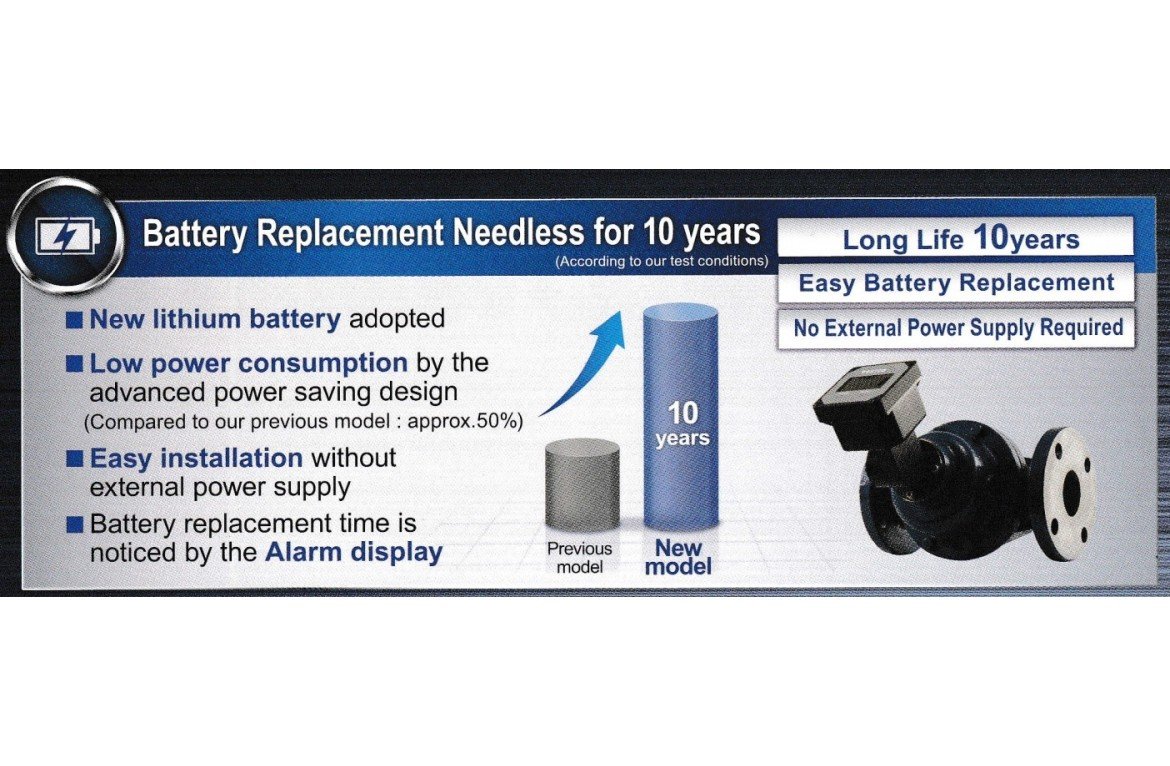
Tokico offers compact gear-type meters, Roots-type meters for larger duties, mechanical totalisers and electronic indicators with selected pulse or analogue outputs. A battery-operated display can also be useful where a local electronic reading is needed but external power is inconvenient.
How a positive displacement flowmeter works
Flow turns a pair of precisely fitted gears or rotors inside the meter body. Each rotation represents a known volume, so counting the rotations produces the total volume and, with an electronic indicator, the flow rate.
- Direct volumetric measurement: Suitable for totalising transferred or consumed liquid.
- Good low-flow performance: Useful where velocity-based instruments may struggle, provided the selected meter covers the actual minimum flow.
- Stable measurement: Tokico Roots-type rotors rotate without contact, helping reduce wear and pressure loss.
- Viscosity-dependent selection: The usable flow range and pressure loss change with the liquid viscosity.
Choose the Tokico meter family
| Series | General size and flow range | Register | Best starting point for |
|---|---|---|---|
| FGB | 15–25 mm; approximately 20–3,000 L/h for mechanical models | Mechanical, pulse option or Electronic 75 Series | Small fuel lines, burners, generators and machinery |
| FRO | 40–50 mm; approximately 0.1–15 m³/h | Mechanical totaliser with selected pulse options | Medium-volume fuel consumption and transfer |
| FRP | 80–100 mm; approximately 0.6–130 m³/h | Mechanical totaliser with selected pulse options | Bulk oil transfer and large-volume measurement |
| FRL | 25–100 mm; approximately 0.07–160 m³/h | Electronic 75 Series display and selected outputs | The broadest electronic range for industrial oil service |
| FRY | 40–50 mm; approximately 0.1–15 m³/h | Electronic 75 Series display and selected outputs | Heavy oil or lubricating oil at temperatures up to 150 °C |
Ranges are a selection guide, not a final model code
Available flow, pressure and temperature limits vary with size, rotor, body, seal and liquid. Confirm the selected catalogue configuration against the actual process conditions.
Mechanical, battery or externally powered?
| Indication arrangement | Main advantage | Choose it when | Check before ordering |
|---|---|---|---|
| Mechanical totaliser | No electrical supply is needed | A durable local accumulated-volume reading is sufficient | Reset or non-reset counter, reading units and pulse requirement |
| Battery-operated electronic display | Clear local digital indication without a permanent external supply | Power cabling is difficult and local flow or total display is required | Battery life and replacement, total retention, ambient rating and available outputs |
| Externally powered electronic indicator | Supports integration and continuous output functions | The PLC, recorder or control system requires pulse, 4–20 mA or alarms | Supply voltage, output suffix, cable entry and receiving input |
| Mechanical meter with pulse transmitter | Keeps local mechanical totalisation while adding remote counting | A PLC, batch counter or remote totaliser needs a contact pulse | Pulse value, contact rating, maximum frequency and cable distance |
A battery display should not automatically be treated as a replacement for an externally powered transmitter. Confirm whether the chosen battery configuration supplies only local indication or also supports the required remote signals.
Tokico Electronic 75 Series output choices
For the Electronic 75 Series, select the hydraulic measuring unit first—FGB, FRL or FRY—then select the indicator and output suffix.
| Electronic variant | Pulse | 4–20 mA | Typical use |
|---|---|---|---|
| 75XX | No | No | Local indication and totalisation |
| 75PX | Yes | No | Remote totaliser, batch controller or PLC counting |
| 75XA | No | Yes | Continuous flow-rate transmission |
| 75PA | Yes | Yes | Applications requiring both totalising pulses and an analogue flow signal |
Match the meter to the liquid
| Liquid or duty | Suitable starting point | Important selection check |
|---|---|---|
| Diesel and kerosene | FGB for small flow; FRO, FRP or FRL for larger flow | Minimum flow, air entrainment, temperature and required totaliser |
| Fuel oil and heavy oil | FGB, FRO, FRP, FRL or FRY according to flow and temperature | Viscosity at operating temperature, heating and pressure loss |
| Lubricating oil | Electronic FGB, FRL or FRY | Viscosity range, temperature, material and output requirement |
| Crude palm oil | Model selected from actual viscosity, temperature and flow | Product temperature, solidification risk, cleaning and compatible construction |
| Gasoline or volatile liquid | Selected FRL or FRP construction only after review | Material compatibility, hazardous-area requirements and vapour formation |
Never select by the liquid name alone. The same oil can have very different viscosity at start-up and normal operating temperature. These changes affect the meter’s usable flow range, pressure loss and starting performance.
Size by flow—not only by pipe diameter
An oversized positive displacement meter may operate below its reliable measuring range during normal production. An undersized meter can create excessive pressure loss, overspeed the measuring element or restrict the process.
- Provide the minimum, normal and maximum flow, including start-up and intermittent conditions.
- State whether the duty is continuous, batching, transfer or consumption monitoring.
- Use viscosity at the actual measuring temperature, not only a room-temperature datasheet value.
- Check allowable pressure loss at the maximum flow and highest expected viscosity.
- Reduce or expand the pipe around the meter when the correct measuring size differs from the existing line.
Recommended installation arrangement
Clean, liquid-full flow is essential. Solid particles can damage or jam a positive displacement meter, while entrained air is measured as apparent volume and can produce an incorrectly high total.
- Install a correctly sized upstream strainer and monitor or clean it routinely.
- Use an air eliminator where tank transfer, suction conditions or empty lines can introduce gas.
- Keep the meter full and provide adequate downstream pressure to prevent flashing.
- Observe the flow-direction arrow and the approved horizontal or vertical orientation.
- Open valves gradually; avoid sudden flow surges and hydraulic shock.
- Provide isolation valves and a bypass when the process must continue during service.
- Support the piping so the meter body does not carry excessive pipe load.
Pulse output, PLC integration and batching
A pulse output represents a defined quantity of liquid. The receiving counter or PLC must use the correct pulse value and must be able to accept the contact type and highest possible pulse frequency.
For a 4–20 mA output, confirm whether the signal represents instantaneous flow rate, the configured upper range and the required power arrangement. Total volume is normally transferred more reliably as pulses or over a dedicated digital interface than as an analogue signal.
For custody, trade or regulated measurement
Do not assume that standard industrial accuracy or a calibration certificate makes an installation legally valid for trade. Confirm the applicable approval, sealing, calibration and local regulatory requirements before purchase.
Common causes of poor readings
| Symptom | Possible cause | What to inspect |
|---|---|---|
| Total is too high | Entrained air, vapour or incorrect pulse scaling | Air eliminator, suction leaks, backpressure and PLC pulse factor |
| Total is too low | Flow below range, bypass leakage, worn parts or missed pulses | Actual minimum flow, valves, meter condition and input wiring |
| Pressure loss is high | Blocked strainer, liquid too viscous or meter undersized | Strainer differential pressure, temperature, viscosity and peak flow |
| Reading is unstable | Two-phase flow, pulsation or rapidly changing flow | Air ingress, pump behaviour, valve operation and line condition |
| No electronic indication | Battery, supply, sensor or configuration issue | Battery condition, supply voltage, wiring and selected suffix |
Maintenance and calibration
Inspect and clean the upstream strainer before contamination reaches the meter. Trend the difference between delivered reference volume and meter total, and investigate a change rather than repeatedly adjusting the scaling.
Calibration should use a liquid and flow range representative of the application whenever practical. Record the meter model, serial number, pulse factor, fluid, temperature, viscosity and test flow points so later results can be compared meaningfully.
Information Seacom needs for selection
- Liquid name and composition
- Viscosity at normal and start-up temperatures
- Minimum, normal and maximum flow
- Normal and design temperature and pressure
- Pipe size, flange standard, orientation and flow direction
- Mechanical, battery or powered electronic indication
- Reset/non-reset totaliser, pulse, 4–20 mA or alarm requirement
- Hazardous-area, material, certification and calibration requirements
Seacom can assist with Tokico model selection, replacement matching, compatible strainers, output configuration and flowmeter calibration. Support is available for projects in Malaysia and other markets, subject to product and delivery availability.
tokico-positive-displacement-flowmeter-hu
All comments