



.png)






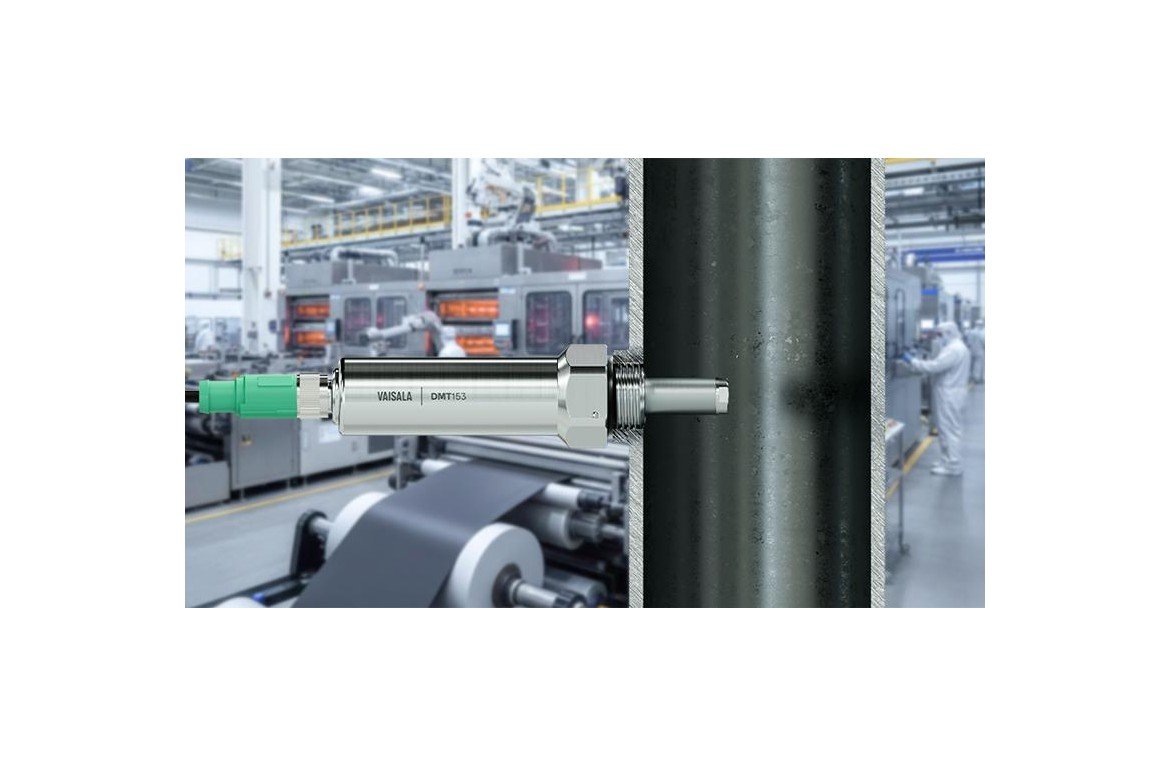
Low Dew Point Sensor Selection for Dry Air and Industrial Gases
Choosing a Low Dew Point Sensor for Your Process
A low dew point sensor measures moisture in dry air or gas where the process requires close control of dryness. Applications include desiccant-dried compressed air, nitrogen supplies, glove boxes and moisture-sensitive manufacturing.
Start with the moisture limit your process must meet. Then assess the sensor's calibrated range, accuracy at that limit, operating conditions and installation requirements. An instrument with a lower minimum reading is not automatically the best choice for every dryer or gas line.
Specify the Measurement Before Selecting the Sensor
A requirement such as “measure down to −80 °C” needs more detail before it can become an instrument specification. Confirm the reported parameter, measurement pressure and required accuracy.
- Dew point or frost point: below freezing, the reference may be saturation over liquid water or over ice. Confirm which convention the process specification and instrument use.
- Measurement pressure: a reading at line pressure and a reading after pressure reduction are not directly interchangeable.
- Calibrated range: check where the manufacturer specifies measurement performance, not just the range displayed or transmitted.
Record these details in the purchase specification and measurement reports so operators and suppliers compare results on a consistent basis.
Calibrated Range Versus Output Range
A sensor may produce values outside its calibrated measurement range. Those values should not be assumed to carry the same accuracy specification.
For example, Vaisala lists the DMT153 calibrated dew/frost point range as −80 to −20 °C Td/f, with a wider non-calibrated measurement range of −100 to +20 °C Td/f. Its specified accuracy is ±2 °C from −80 to −40 °C Td/f and ±3 °C from −40 to −20 °C Td/f.
For an application operating near −80 °C Td/f, assess the calibrated performance at that point and the uncertainty your process can accept. A displayed −100 °C value does not establish calibrated performance at −100 °C.
Vaisala Options to Review
| Measurement need | Instrument to review | Selection focus |
|---|---|---|
| Ultra-dry air and suitable industrial gases | Vaisala DMT153 | Calibrated performance down to −80 °C Td/f, gas compatibility and system integration. |
| Compact dryer and OEM installations | Vaisala DMT143 / DMT143L | Required dew point range, sensor configuration, output and available mounting space. |
| Pressurised pipeline measurement | Vaisala DMP8 | Process conditions, installation fittings and the required display or interface. |
These instruments serve different installation and measurement needs. Confirm the exact configuration against the application before ordering.
DMT153 for Ultra-Dry Air and Gases
The Vaisala DMT153 dew point transmitter is intended for very dry applications, including critical compressed air and suitable nitrogen, argon and helium lines. It supports the Indigo platform, including the Indigo80 handheld indicator, and offers analog output options or RS-485 communication with Modbus RTU.
For an existing DMT152 installation, review the DMT153 replacement requirements before ordering. Check the process thread, connector, cable, electrical supply, output scaling and receiving system rather than assuming the existing installation can be reused without changes.
Provide the full gas composition and any contaminants when requesting a selection. A sensor's suitability for dry nitrogen does not establish suitability for every gas mixture.
Why a Very Dry Reading Can Take Time to Stabilise
The complete installation affects response. Moisture retained on sample-line surfaces, unsuitable tubing, leaks and stagnant sections can delay or distort the gas conditions reaching the sensor.
- Use short, leak-tight sample lines with suitable materials, preferably stainless steel for dry measurements.
- Maintain the intended pressure at the sensor.
- Purge the sample path with process gas and avoid dead ends.
- Prevent condensation in the sample line.
- Allow the instrument to complete its specified start-up and warm-up sequence.
Do not treat a quoted sensor response time as a guarantee for the entire installed system. Document when the measurement has stabilised and investigate the sample path if readings remain inconsistent.
Information to Include in Your Enquiry
- Gas type, composition and known contaminants.
- Normal dew point, process limit and expected wetter excursions.
- Required accuracy and calibration points.
- Minimum and maximum operating pressure and gas temperature.
- Direct installation or sampling arrangement, including connection size.
- Required analog signal, digital communication, display and logging.
For dryer-monitoring applications, also read our guide to dew point measurement in compressed air.
Explore Dew Point Meters and Transmitters
Compare the wider range of dew point meters, sensors and transmitters supplied by Seacom to review instruments for portable checks, continuous monitoring and industrial drying applications.
Discuss Your Low Dew Point Measurement Application with Seacom
Seacom Process Instruments Sdn Bhd can help you select a Vaisala low dew point sensor for dry air and industrial gas applications. Send us your gas type, operating pressure, target dew point and preferred output so we can review a suitable instrument configuration and sampling arrangement.
Email: seacom@seacom.com.my
WhatsApp: +60 16 208 0697
All comments