



.png)








Problem With Your Dryer? Troubleshooting Plastic-Pellet Drying
The dryer can be running while the pellets remain wet
A plastic dryer may show the correct setpoint and complete its normal cycle, yet the moulded parts still develop splay, bubbles, poor surface finish or reduced strength. Before increasing the drying time, confirm whether the dryer is actually delivering the required conditions throughout the complete cycle.
Most resin-drying problems can be traced to four connected conditions: temperature, dew point, residence time and airflow. Looking at them together gives a much clearer diagnosis than relying on the heater display alone.
This guide explains what each condition does, where to measure dew point and how the measurement trend can reveal common desiccant-dryer problems.
Why proper plastic-pellet drying matters
Hygroscopic polymers such as PET and polyamide absorb water into their internal structure. During injection moulding, blow moulding or extrusion, this moisture can react with the molten polymer. The result may be hydrolysis, lower mechanical strength, inconsistent processing and visible defects.
More drying is not automatically better. An unnecessarily long cycle consumes energy, reduces throughput and may expose temperature-sensitive materials to excessive heat. The objective is to create the specified drying conditions and confirm when the material is ready for processing.
Use the resin supplier's drying specification
The required temperature, dew point and residence time depend on the material grade and process. Do not apply one generic dew-point target to every polymer.
The four conditions behind effective resin drying
| Condition | Why it matters | What to verify |
|---|---|---|
| Temperature | Heat weakens the bond between water molecules and the polymer so moisture can migrate out of the pellet. | Measure the actual resin temperature through the hopper instead of relying only on the heater setpoint. |
| Dew point | Low-dew-point air has a low water-vapour pressure and can accept moisture released by the heated resin. | Trend the drying-air dew point across the complete desiccant cycle, including bed changeover. |
| Residence time | The resin needs enough time at the correct temperature and dew point for moisture to move from the pellet core to its surface. | Compare hopper volume, material level and throughput with the resin supplier's specified drying time. |
| Airflow | Hot, dry air must deliver heat evenly and carry released moisture back to the dryer. | Check filters, hoses, blowers, hopper loading and whether air is channeling through the pellet bed. |
Start with a physical inspection
Before changing controller settings, inspect the parts of the dryer that most often affect airflow and moisture loading.
- Clogged, ruptured or incorrectly installed air filters
- Collapsed, frayed, disconnected or poorly insulated hoses
- Ambient-air leaks at hose joints, loaders and hopper covers
- An underfilled hopper allowing air to channel through the centre
- A blocked or ineffective return-air cooler
- Worn, contaminated or incompletely regenerated desiccant
- A failed process heater, regeneration heater or blower
- Incorrect blower rotation or a valve failing to change desiccant beds
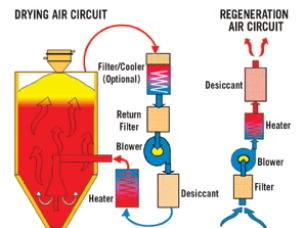
Figure 1. A return-air filter and heat exchanger help protect the desiccant from contamination and excessive temperature. Both conditions can reduce moisture-removal performance.
Check the temperature profile inside the hopper
The temperature shown by the dryer controller may not represent the complete pellet bed. Measure at several levels in the hopper and compare the temperature profile with the material throughput and required residence time.
For example, if a resin requires four hours of drying, the material located at the four-hour residence level should already be at the specified drying temperature. A colder zone may indicate insufficient airflow, heat loss, incorrect loading or excessive throughput.
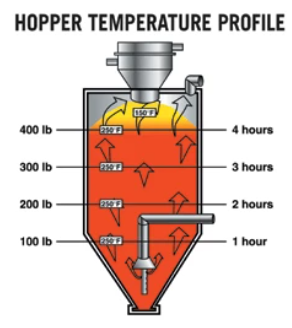
Figure 2. A hopper temperature profile helps confirm whether the resin reaches the required drying temperature early enough to complete its specified residence time.
Use dew point to understand the dryer cycle
A single spot reading can miss a short-lived problem. Trend the drying-air dew point across an entire cycle and observe what happens when the dryer changes desiccant beds.
| Observed pattern | Possible cause | What to inspect |
|---|---|---|
| Short spike immediately after bed changeover | Regenerated desiccant entered service before it cooled sufficiently. | Cooling stage, bed-change timing, return-air temperature and aftercooler |
| Good reading after changeover, followed by a rapid rise | Premature desiccant loading, air leakage, incomplete regeneration or contamination | Seals, hoses, filters, regeneration heater, valves and desiccant condition |
| Supply-air dew point remains close to return-air dew point | Regeneration circuit inactive or desiccant badly degraded | Regeneration blower and heater, valve operation, desiccant and controller sequence |
| Dew point is stable, but the resin remains wet | Temperature, residence time or airflow may be outside specification. | Actual hopper profile, throughput, pellet level, airflow and material recipe |
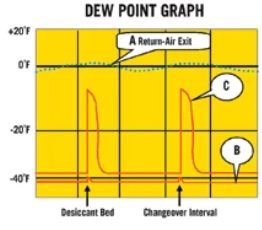
Figure 3. Comparing the dry-air inlet and return-air dew point can reveal normal performance, incomplete desiccant cooling and other regeneration problems.
Where should the dew-point sensor be installed?
| Measurement point | What it tells you | Installation consideration |
|---|---|---|
| Dryer outlet, before the process heater and hopper | Confirms the dryness of the air produced by the desiccant system. | Usually the preferred point for dryer control and condition monitoring |
| After the process heater | Checks the air delivered towards the hopper. | If temperature exceeds the sensor limit, use a representative sampling system to cool and, where necessary, filter the sample. |
| Hopper return-air outlet | Shows the moisture being released by the pellets and helps assess drying progress. | Hot sample air may need cooling before it reaches the sensor. |
For a low-pressure or near-atmospheric sampling point, the sample line may require a pump. Keep the tubing short, leak-tight and suitable for low-humidity measurement. The sample must represent the process rather than room air entering through a poor connection.
Common dryer problems and where to look first
- Restricted airflow: Inspect clogged filters, collapsed hoses and blower operation.
- Air channeling through the hopper: Confirm the hopper is properly filled and the diffuser is working as intended.
- Wet ambient air entering the circuit: Inspect loaders, covers, hose joints and seals.
- Desiccant returning to service too hot: Check the cooling stage and return-air cooler.
- Reduced desiccant effectiveness: Look for age, contamination, incomplete regeneration and carryover from damaged filters.
- No effective regeneration: Check the regeneration heater, blower, valves and controller sequence.
- One bed remains continuously online: Confirm that airflow is transferred when the controller commands a bed change.
Selecting a Vaisala dew-point instrument for plastics drying
The suitable instrument depends on the expected dew-point range, air temperature, process pressure, installation method and whether the measurement is permanent or portable.
| Measurement need | Recommended starting point | Why it fits |
|---|---|---|
| Compact plastic dryer or OEM installation | Vaisala DMT143 or DMT143L | Compact permanent transmitter for small industrial dryers and sampling arrangements |
| Direct measurement in a hot process up to +180 °C | Vaisala DMP5 | Long probe for direct in-line measurement through insulation or a thick process wall |
| Direct measurement in a very-hot process up to +350 °C | Vaisala DMP6 | Passive probe cooling allows measurement without cooling water or a powered cooling system. |
| Portable dryer surveys, spot checks and troubleshooting | Vaisala Indigo80 with DMP80 | Portable measurement, logging, field checks and comparison between several dryers |
| Browse the wider range | Vaisala dew-point instruments | Compare fixed, portable, high-temperature and sampling-system options |
Replacing instruments named in the original article
The earlier version referred to products that have since entered their replacement phase. They remain relevant to existing installations, but should not be the first choice for a new project.
| Legacy instrument | Current direction |
|---|---|
| Vaisala DMT340 Series | Select a suitable DMP smart probe and Indigo transmitter after reviewing the former probe model, temperature, pressure, fitting and outputs. |
| Vaisala DMT345 and DMT346 | Use DMP5 as the starting point for applications up to +180 °C and DMP6 for very-hot processes up to +350 °C. |
| Vaisala DM70 | Use Indigo80 with a suitable DMP80 probe for portable measurements and field diagnostics. |
A practical dryer-troubleshooting sequence
- Confirm the requirement: Identify the resin grade and its specified drying temperature, dew point and residence time.
- Inspect the dryer: Check filters, hoses, hopper loading, seals, blowers, heaters, valves and desiccant condition.
- Measure the hopper: Record the temperature profile instead of relying only on the heater display.
- Trend the dew point: Capture a complete desiccant cycle, including bed changeover.
- Compare inlet and return air: Distinguish dryer performance from moisture being released by the resin.
- Verify the correction: Repeat the same measurements after maintenance or adjustment.
Plastic-dryer dew-point measurement support in Malaysia
Seacom Process Instruments supplies and supports Vaisala dew-point instruments for plastic dryers and industrial drying applications throughout Malaysia. Our team can assist with selecting a fixed transmitter, high-temperature probe, portable instrument, sampling cell, process connection and system output.
Send us the resin type, required dew point, process-air temperature and pressure, proposed measurement location, pipe or duct connection and required output. If you are troubleshooting an operating dryer, include its dew-point trend and the conditions present when the problem occurs.
All comments