


.png)








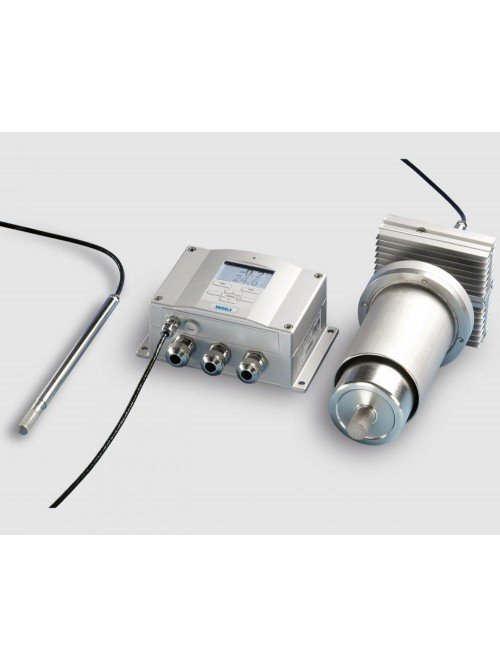
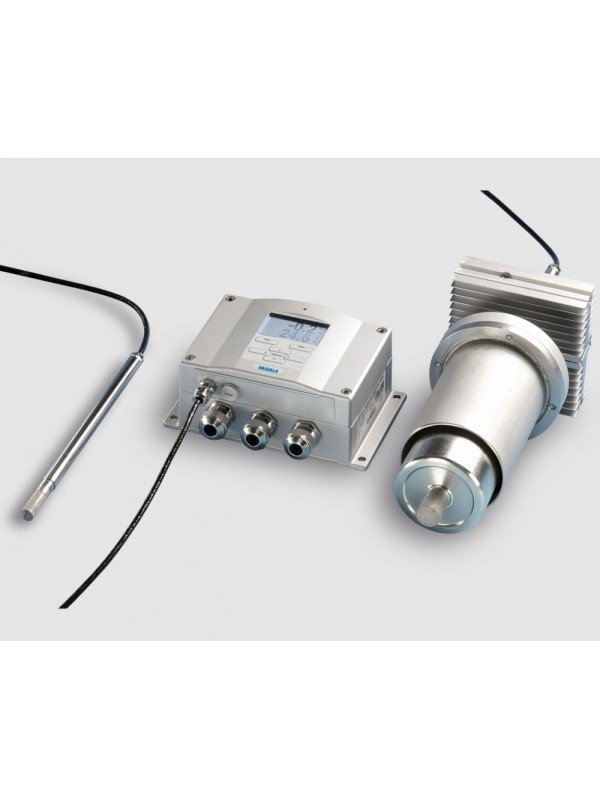
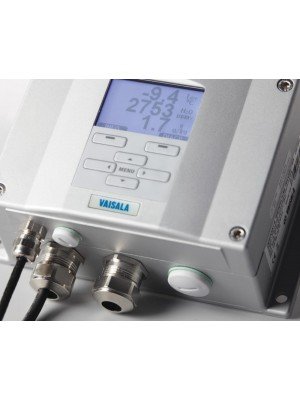
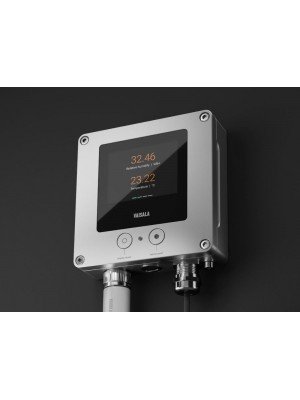
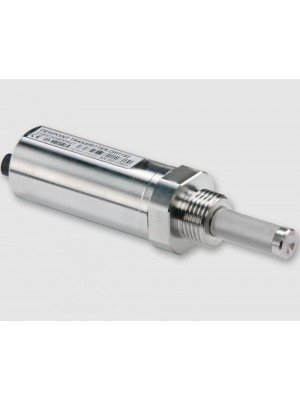
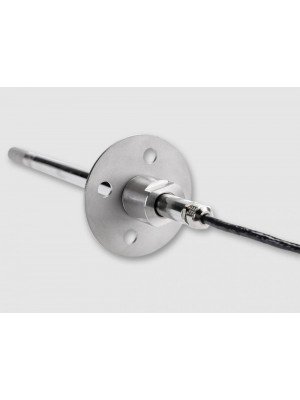
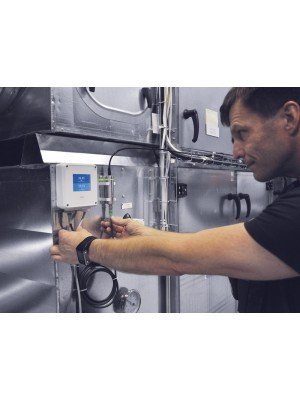
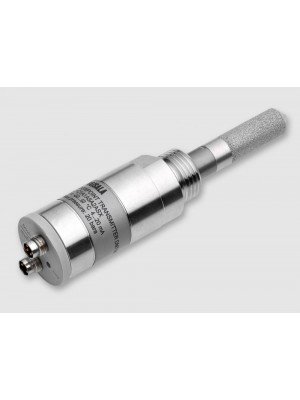
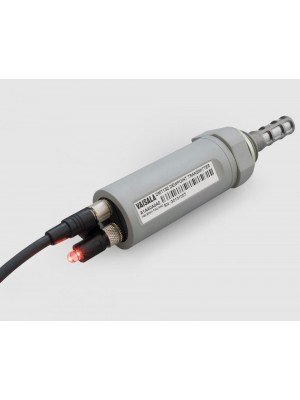
The Vaisala DMT345 and DMT346 provided direct dew-point measurement in hot industrial drying processes. Both models are discontinued and replaced by Vaisala DMP5 or DMP6 smart probes with an Indigo transmitter.
The Vaisala DMT345 and DMT346 provided direct dew-point measurement in hot industrial drying processes. Both models are discontinued and replaced by Vaisala DMP5 or DMP6 smart probes with an Indigo transmitter.
Product status: The Vaisala DMT345 and DMT346 are discontinued. Vaisala identifies DMP5 and DMP6 with an Indigo500 Series transmitter as their current equivalents: use DMP5 for high-temperature processes up to +180 °C and DMP6 for very-high-temperature processes up to +350 °C.
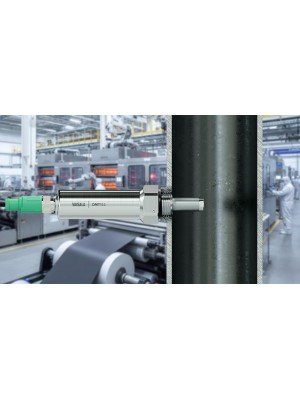
The Vaisala DMT345 and DMT346 were developed for dew-point and humidity measurement in industrial drying processes where ordinary probes cannot tolerate the process temperature. Direct installation avoided long sampling lines, sample cooling and trace heating, helping the measurement represent the real conditions inside the process.
Typical applications included industrial ovens, kilns, dryers, food processing, ceramics, timber drying and other hot, low-humidity processes. The correct model depended primarily on the process-temperature range and the required probe installation.
| Selection point | DMT345 | DMT346 |
|---|---|---|
| Legacy application | Hot and dry industrial processes | Very-hot industrial processes |
| Process-temperature capability | Up to +180 °C | Best performance from approximately +140 to +350 °C |
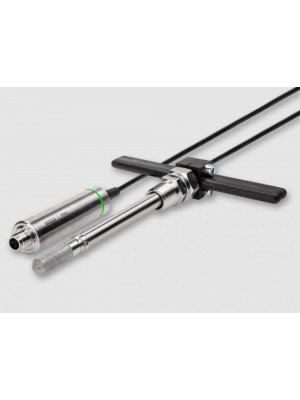
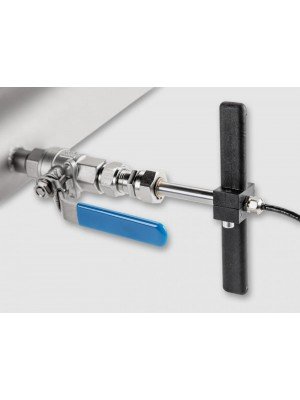
| Probe arrangement | Long stainless-steel probe with adjustable installation depth | Probe installed through a passive cooling set |
| Cooling requirement | No separate cooling system normally required | Passive cooling set supplied as part of the measurement arrangement |
| Current equivalent | DMP5 + Indigo transmitter | DMP6 + Indigo transmitter |
| Selection point | DMP5 | DMP6 |
|---|---|---|
| Replaces | DMT345 | DMT346 |
| Best application | Direct measurement in hot processes, ovens and dryers | Direct measurement in very-hot processes and furnaces |
| Probe-head operating range | −40 to +180 °C | +100 to +350 °C for direct high-temperature operation |
| Dew-point range | −40 to +100 °C Td/f | −25 to +100 °C Td/f |
| Dew-point accuracy | Up to ±2 °C Td/f | Up to ±2 °C Td/f |
| Temperature measurement | 0 to +180 °C; ±0.4 °C at +100 °C | Cooling arrangement protects the sensor; select a separate temperature measurement if required by the application |
| Mechanical arrangement | Long probe; optional flange and adjustable insertion depth | Probe with passive cooling set and configurable cooling fins |
| Standalone communication | Modbus RTU over RS-485 | Modbus RTU over RS-485 |
| Portable and service tools | Indigo80 and Vaisala Insight software | Indigo80 and Vaisala Insight software |
Explore the Vaisala DMP5 for processes up to +180 °C
Explore the Vaisala DMP6 for processes up to +350 °C
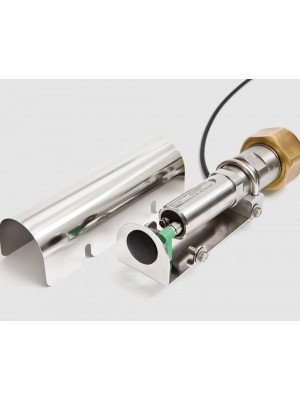
The DMP6 uses a passive cooling set to conduct heat away from the probe head and keep the sensor within its permitted temperature. The system has no moving parts and requires no cooling water, compressed air or separate electrical supply.
The cooling-fin arrangement must match the actual process temperature and air movement. High gas velocity can change the cooling performance, so the probe should be commissioned under representative conditions and its diagnostic values checked after stabilisation.
DMP6 installation limit: the process may reach +350 °C, but the sensor itself must remain within its permitted temperature. Cooling-set installation, insertion depth, cooling fins and process velocity must therefore be reviewed as one complete arrangement.
DMP5 and DMP6 include Modbus RTU and can operate as standalone smart probes. Add an Indigo transmitter when the installation requires a local display, analog signals, relays, additional power options, data logging or Ethernet connectivity.
| Transmitter | Typical reason to select it | Main system features |
|---|---|---|
| Indigo201 | Compact single-probe installation requiring analog outputs and relays | Three analog outputs and two relays |
| Indigo202 | Compact single-probe installation using Modbus RTU and relays | Digital communication and two relays |
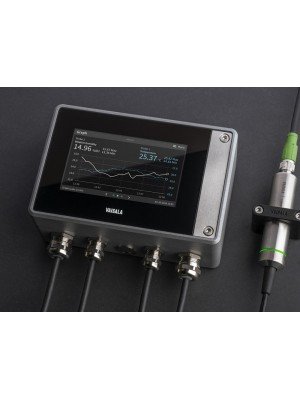
| Indigo300 | Rugged local display with straightforward analog integration | Metal enclosure, colour display and up to three analog outputs |
| Indigo510 | Flagship single-probe installation | Two isolated analog outputs, Ethernet web interface and Modbus TCP |
| Indigo520 | Dual-probe or relay-intensive installation | Two probe inputs, four isolated analog outputs, two relays, logging and Modbus TCP |
| Indigo80 | Portable commissioning, spot-checking and service work | Connect up to two compatible probes for display, diagnostics, data logging, calibration and adjustment |
Explore Vaisala Indigo201 and Indigo202 transmitters
Explore the Vaisala Indigo300 transmitter
Compare Vaisala Indigo510 and Indigo520 transmitters
Explore the Vaisala Indigo80 handheld indicator
| Probe | Main strength | Typical application | Product page |
|---|---|---|---|
| DMP1 | Fixed probe for low-humidity rooms | Battery dry rooms and semiconductor areas | View Vaisala DMP1 |
| DMP5 | Long probe for temperatures up to +180 °C | Ovens, dryers and high-temperature processes | View Vaisala DMP5 |
| DMP6 | Passive cooling for temperatures up to +350 °C | Very-hot dryers, ovens and furnaces | View Vaisala DMP6 |
| DMP7 | Short remote probe for limited spaces | Compact equipment, dry rooms and semiconductor tools | View Vaisala DMP7 |
| DMP8 | Adjustable insertion for pressurised pipelines | Compressed air and pressurised industrial gases | View Vaisala DMP8 |
The legacy probe flange or opening may not provide a direct mechanical fit for the new probe. Check insertion depth, sealing, cable routing and the surrounding temperature before manufacturing an adapter or modifying the process connection.
For an operating transmitter, retain its order code, probe arrangement, output scaling, relay settings, communication configuration, installation drawings and calibration history. These details are necessary for service support and for specifying the correct DMP and Indigo replacement.
A functioning legacy transmitter does not need to be removed solely because it is discontinued. Plan the change according to calibration status, spare availability, shutdown access and the risk that measurement failure presents to production.
Seacom Process Instruments supports existing Vaisala DMT345 and DMT346 installations in Malaysia and supplies current DMP5, DMP6 and Indigo transmitter configurations for industrial dryers, ovens, kilns and other high-temperature processes.
Our team can assist with process-temperature review, cooling-set selection, insertion depth, mounting flanges, Indigo transmitter configuration, analog and digital integration, commissioning and calibration planning.
Contact Seacom with the legacy model code, process-temperature range, dew-point requirement, gas velocity, process dimensions, outputs and control-system details so we can assess the appropriate DMP5 or DMP6 replacement arrangement.
Download |

.
The Vaisala DMT340 Series provided configurable dew-point and temperature measurement for industrial low-humidity applications. The series is discontinued and replaced by Vaisala Indigo500 transmitters with DMP7 or DMP8 smart probes.
The Vaisala DRYCAP® Dew Point and Temperature Probe DMP7 is designed for accurate low-humidity measurement where installation space is limited.
The Vaisala Indigo500 Series provides flagship industrial measurement integration: choose Indigo510 for a simplified single-probe system or Indigo520 for full dual-probe capability.
The Vaisala DPT145 provides online dew-point, pressure and temperature measurement for SF6-insulated electrical equipment. The model is being discontinued and should not be specified for new projects.
The Vaisala Indigo300 is a rugged industrial transmitter for one Vaisala Indigo-compatible smart probe, providing local measurement display and up to three configurable analog outputs.
Its corrosion-resistant IP66 metal enclosure, flexible probe mounting and interchangeable probe design make Indigo300 suitable for humidity, temperature, dew point, CO2, moisture in oil and other demanding industrial measurements.
The Vaisala DMT152 provides accurate dew-point measurement down to −80 °C Td/f for ultra-dry industrial and OEM applications. This model is discontinued and has been replaced by the Vaisala DMT153.
The Vaisala DRYCAP® Dew Point and Temperature Probe DMP5 measures humidity directly in hot industrial processes with a long stainless-steel probe and adjustable installation depth.
The Vaisala Indigo200 Series is the standard transmitter platform for one interchangeable Indigo-compatible smart probe, providing local display and practical automation-system connectivity.
The Vaisala DMT143 and DMT143L provide compact, dependable dew-point measurement for small industrial dryers, compressed-air systems, glove boxes and OEM equipment.
The Vaisala DMT153 provides traceable low-dew-point measurement for ultra-dry industrial processes. It is the current replacement for the DMT152, with modern analog, Modbus and Vaisala Indigo connectivity.
The Vaisala DMT132 is a compact and economical dew-point transmitter designed to verify refrigerant-dryer performance by measuring the actual outlet-air dew point.
The Vaisala DRYCAP® Dew Point and Temperature Probe DMP8 provides reliable low-humidity measurement in pressurised pipelines with adjustable installation depth.
The Vaisala DMT345 and DMT346 provided direct dew-point measurement in hot industrial drying processes. Both models are discontinued and replaced by Vaisala DMP5 or DMP6 smart probes with an Indigo transmitter.
 DMP6 catalogue
(1.02M)
DMP6 catalogue
(1.02M)