



.png)









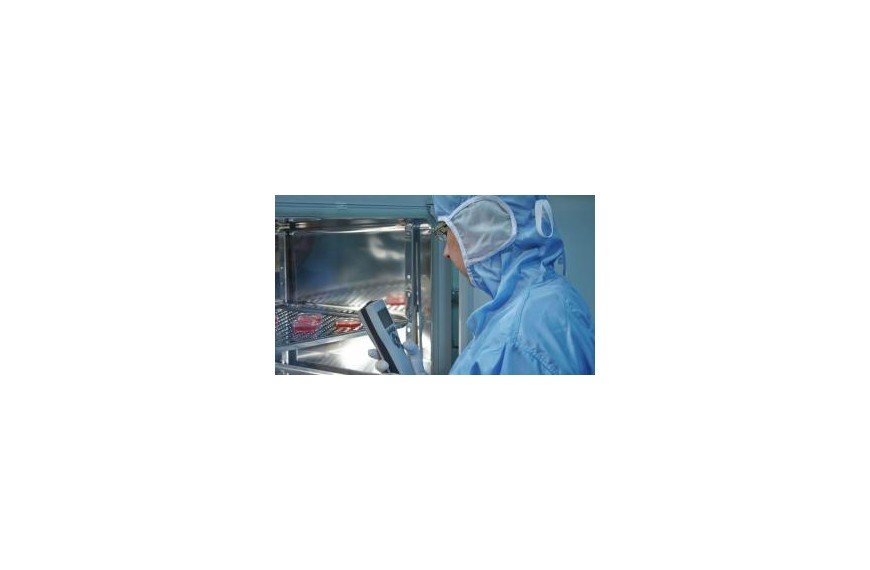
Portable Spot Checking for Industrial Measurements
Portable Spot Checking for Industrial Measurements
Portable measuring instruments are useful when a measurement is needed at a specific location without installing a permanent transmitter. They can be used for quick process checks, troubleshooting, short-term measurement, comparison against an installed sensor or field verification before deciding whether a permanent measurement point is required.
Typical spot-checking applications include humidity, temperature, dew point, carbon dioxide and moisture in oil. The same basic idea applies across many industries: bring a suitable reference instrument to the measurement point, allow the reading to stabilise and compare the result with the process or installed instrument.

What Is Spot Checking?
Spot checking is a portable measurement taken at a particular location and time to understand the actual condition of a process, room, chamber, pipeline or piece of equipment.
Unlike a permanently installed transmitter, a portable instrument can be moved between measurement points. This makes it particularly useful when several locations need to be checked using the same reference instrument.
Portable measurements can help answer practical questions such as:
- Is the installed transmitter showing a reasonable value?
- Is humidity uniform across the room or chamber?
- Has the compressed-air dew point improved after dryer maintenance?
- Is an incubator maintaining the expected CO₂ concentration?
- Is moisture increasing in transformer, lubrication or hydraulic oil?
- Is there a local environmental problem that is not visible from the main control-system reading?
Why Use a Portable Reference Instrument?
A permanently installed transmitter normally measures one defined point continuously. That is exactly what is required for process control and continuous monitoring, but it does not always tell the complete story when troubleshooting.
A portable instrument allows technicians to move around the process and compare several locations. It can also provide an independent reference when checking the behaviour of a permanently installed measurement device.
- Quick investigation without installing another permanent transmitter
- Comparison of several measurement points
- Short-term measurement and data logging
- Checking an installed transmitter against a portable reference
- Process troubleshooting before and after maintenance
- Verification following sensor replacement or adjustment
- Measurement at locations that are only accessed occasionally

Humidity and Temperature Spot Checking
Portable humidity and temperature measurements are widely used in pharmaceutical facilities, cleanrooms, laboratories, warehouses, HVAC systems, environmental chambers, production areas and general industrial environments.
A technician may compare the portable reference against a wall-mounted or duct-mounted transmitter, investigate differences between locations or temporarily log conditions while diagnosing an environmental-control problem.
Important considerations include:
- Allowing sufficient time for the probe to stabilise
- Avoiding direct handling or body heat around the sensing element
- Checking whether temperature differences are affecting relative humidity
- Taking measurements at representative locations
- Using a probe suitable for the expected temperature range
Dew Point Spot Checking
Portable dew-point measurement is commonly used for compressed air, industrial dryers, dry rooms, glove boxes and compatible process gases.
A portable dew-point meter can be particularly useful during commissioning or troubleshooting because it can be moved between different points in the compressed-air network.
For example, measurements can be compared:
- Before and after an air dryer
- At different distribution points
- At a critical machine or process inlet
- Before and after dryer maintenance
- Against an installed dew-point transmitter
For pressurised systems, the sampling arrangement, measurement pressure and gas flow can strongly affect the result. The measurement setup should therefore be considered together with the portable instrument.
For more information on portable low-dew-point measurement, see our dew point instruments for compressed air and dry gases .
CO₂ Spot Checking
Portable carbon-dioxide measurement is useful for incubators, chambers, controlled environments and other applications where the CO₂ concentration needs to be checked independently.
One common example is checking a CO₂ incubator. A portable reference instrument allows the technician to sample the chamber through the appropriate access or sampling point and compare the measurement against the incubator's own indication.
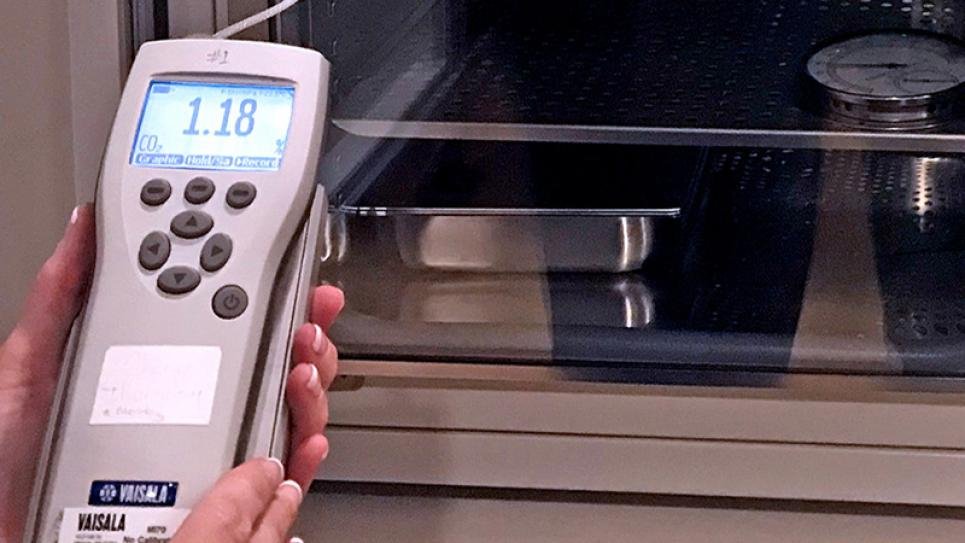
This type of measurement can be useful during routine checks, troubleshooting, maintenance or when investigating differences between an incubator display and an independent measurement.
Moisture-in-Oil Spot Checking
Moisture in transformer oil, lubrication oil and hydraulic fluid can provide useful information about the condition of the oil system and possible water ingress.
Portable measurements are useful when continuous monitoring is not installed at every location or when a technician needs to investigate several systems with one measurement setup.
The Vaisala MMP8 Moisture in Oil and Temperature Probe can be used with a portable Indigo80 indicator for field diagnostics and portable moisture-in-oil measurement, in addition to its use in permanent installations.
Spot Checking Is Not the Same as Continuous Monitoring
Portable measurement and permanent measurement serve different purposes.
| Portable Spot Checking | Permanent Measurement |
|---|---|
| Measurement when required | Continuous measurement |
| One instrument can be moved between locations | Each transmitter normally remains at its measurement point |
| Useful for troubleshooting and comparison | Useful for process control, alarms and continuous records |
| Suitable for short-term logging | Suitable for long-term monitoring |
| Can act as an independent field reference | Normally forms part of the installed process or monitoring system |
In many plants, both approaches are useful. Permanent transmitters provide continuous information, while a portable reference instrument is kept available for checking, maintenance and troubleshooting.
Using Portable Instruments to Check Fixed Transmitters
One of the most useful applications for a handheld reference instrument is checking an installed transmitter in the field.
The portable probe should be placed as close as practical to the sensing location of the installed instrument. Both devices should be given enough time to reach stable conditions before their readings are compared.
A difference between two readings does not automatically mean that one instrument is faulty. Possible causes include:
- Different measurement locations
- Temperature gradients
- Different response times
- Airflow around the sensors
- Sampling-system effects
- Pressure differences
- Contamination
- Calibration drift
The comparison should therefore be performed under controlled and understood conditions.
Spot Checking, Field Checking and Calibration
These terms are sometimes used interchangeably, but they are not exactly the same.
| Activity | Purpose |
|---|---|
| Spot checking | Measure a condition at a particular point or time |
| Field checking | Compare an installed instrument with a suitable portable reference |
| Calibration | Document the relationship between the instrument reading and a recognised reference under defined conditions |
| Adjustment | Change the instrument response to bring it closer to the reference where supported and appropriate |
A quick field comparison is useful for troubleshooting, but it should not automatically be treated as a formal calibration certificate. The required procedure depends on the site's quality system, traceability requirements and application.
Common Applications for Portable Measurement
Portable spot-checking instruments are used across a wide range of industries.
| Application | Typical Measurements |
|---|---|
| Pharmaceutical and cleanrooms | Humidity and temperature |
| HVAC and building automation | Humidity, temperature and CO₂ |
| Compressed-air systems | Dew point |
| Industrial dryers | Dew point, humidity and temperature |
| CO₂ incubators | Carbon dioxide |
| Environmental chambers | Humidity and temperature |
| Transformer and lubrication oil | Moisture in oil and temperature |
| Process troubleshooting | Parameter depends on the process |
Choosing a Portable Measurement System
The correct portable instrument depends on more than the parameter name. Before selecting a handheld system, consider:
- What parameter needs to be measured?
- What is the expected measurement range?
- What accuracy is required?
- Will the measurement be made directly or through a sampling system?
- Is the process pressurised?
- Is short-term data logging required?
- Will the instrument also be used to check fixed transmitters?
- Are several different parameters likely to be measured using the same portable platform?
For organisations measuring more than one parameter, a modular platform can reduce the need for several completely separate handheld indicators.
Indigo80 as the Current Modular Portable Platform
For new Vaisala portable measurement applications, the Vaisala Indigo80 Portable Meter provides a modern modular platform for industrial spot checking, field diagnostics, data logging and supported field-calibration work.
Instead of using a completely separate handheld indicator for every parameter, Indigo80 can be connected to compatible Vaisala smart probes according to the measurement required.
It also supports connection of two compatible measurement devices simultaneously, which can be useful when comparing probes, checking more than one parameter or carrying out field verification work.
| Portable Configuration | Main Measurement | Typical Use |
|---|---|---|
| Indigo80 + HMP80 | Relative humidity and temperature | Cleanrooms, HVAC, chambers, warehouses and industrial environments |
| Indigo80 + DMP80 | Dew point and temperature | Compressed air, dryers, dry gases and low-humidity processes |
| Indigo80 + GMP80P | Carbon dioxide | CO₂ incubators and portable gas sampling |
| Indigo80 + MMP8 | Moisture in oil and temperature | Transformer oil, lubrication oil and hydraulic systems |
The advantage is not simply that one display can measure different parameters. The modular approach also allows the measurement probe to be selected according to the actual process conditions.
View Vaisala Indigo80 portable measurement system
What About HM70, DM70, MM70 and Earlier Handheld Instruments?
Many industrial sites already use earlier-generation portable instruments such as Vaisala HM70 for humidity, DM70 for dew point, MM70 for moisture in oil or GM-series instruments for portable CO₂ measurements.
These instruments helped establish the modular spot-checking approach shown in the original examples in this article. Existing instruments may continue to be used according to their condition, calibration status and available support.
For new portable measurement projects, however, the Indigo80 platform with the appropriate current probe should normally be considered first.
For example:
- HM70 applications can move to Indigo80 with HMP80
- DM70 applications can move to Indigo80 with DMP80
- Portable moisture-in-oil work can use Indigo80 with MMP8
- Portable incubator CO₂ checks can use Indigo80 with GMP80P
Portable Measurement Support in Malaysia
Seacom Process Instruments supplies and supports portable industrial measurement instruments for humidity, temperature, dew point, carbon dioxide, moisture in oil and related process applications in Malaysia.
Our team can help determine whether the requirement is best handled by a portable spot-checking instrument, a permanent transmitter or a combination of both.
When asking about a portable measurement application, it is useful to provide:
- Parameter to be measured
- Expected measurement range
- Process temperature and pressure
- Gas, air, oil or environmental application
- Whether direct insertion or sampling is required
- Required accuracy
- Whether data logging is needed
- Existing fixed transmitter model, if the portable unit will be used for field checking
- Calibration or traceability requirements
Choosing the correct portable measurement system starts with the application rather than the instrument name. Once the parameter, range and process conditions are understood, the appropriate handheld indicator, probe and accessories can be selected.
Ask Seacom about portable spot checking
View Vaisala Indigo80 Browse humidity meters Browse dew point meters Browse moisture instruments