- Out-of-Stock
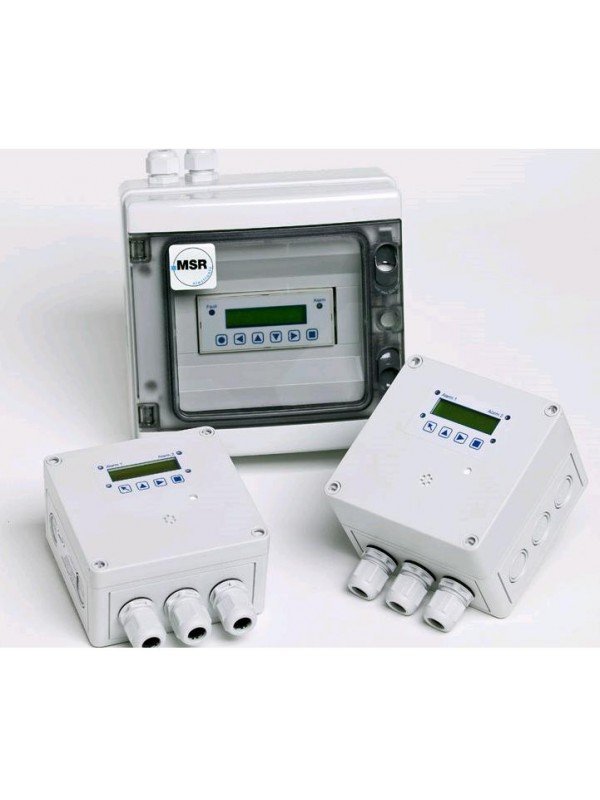



The MSR µ-Gard MA-4 is a fixed analogue transmitter for continuous monitoring of specified Freon and refrigerant gases in ambient air.
The MSR µ-Gard MA-4 continuously monitors ambient air for a specified refrigerant gas. It converts the sensor measurement into an analogue signal for a compatible gas controller, PLC or building-management system, allowing the wider system to generate alarms, start ventilation or initiate a defined safety response.
“Freon” is commonly used as a general term, but refrigerants have different chemical compositions and sensor responses. The correct transmitter must therefore be selected using the exact refrigerant designation, required measuring range, room conditions and alarm strategy.
Model-status check: MA-4 belongs to an earlier MSR product generation and is not shown among MSR’s current product series. Confirm product availability, replacement-sensor support and the suitable present-day MSR refrigerant detector before specifying it for a new installation.
| Function | MA-4 provision | Selection consideration |
|---|---|---|
| Measurement duty | Continuous monitoring of ambient air for gases and vapours | Specify the exact refrigerant rather than “Freon” alone |
| Typical locations | Chiller rooms, refrigeration plants, mechanical rooms and commercial facilities | Review equipment layout, ventilation and likely leak sources |
| Current output | 4–20 mA analogue signal | Match supply, loop arrangement, scaling and controller input |
| Voltage output | 0–10 V analogue signal on the applicable configuration | Confirm input impedance, common reference and cable distance |
| Controller integration | Connection to a suitable MSR controller or compatible automation system | Confirm alarm logic, fault handling and output compatibility |
| Calibration | Factory calibration for the ordered refrigerant and range | Record the calibration gas, range and product code |
| Selection item | Information required | Why it matters |
|---|---|---|
| Refrigerant | Exact designation from the chiller or refrigeration equipment nameplate | Sensor response and calibration differ between refrigerants |
| Concentration range | Required ppm range and alarm thresholds | Determines transmitter scaling and controller programming |
| Application | Leak warning, occupational exposure monitoring or emergency alarm | Determines alarm philosophy, redundancy and response actions |
| Room layout | Dimensions, equipment position, pits, trenches, ventilation and airflow | Determines detector quantity and mounting location |
| Environment | Temperature, humidity, condensation, cleaning chemicals and dust | Affects sensor selection, service life and enclosure suitability |
| System interface | MSR controller, PLC, BMS or standalone alarm requirement | Determines output, wiring, relays and communication architecture |
| Site classification | General area or classified hazardous area | Determines the required detector construction and certification |
| Connection | Typical use | Check before ordering |
|---|---|---|
| 4–20 mA | Gas controller, PLC or remote analogue-input module | Supply arrangement, scaling, cable, fault current and input isolation |
| 0–10 V | Compatible HVAC or building-management input | Common reference, input impedance, wiring distance and noise |
| Gas controller | Central display, alarm relays, sounders, beacons and ventilation commands | Channel capacity, alarm levels, relay logic, backup power and event handling |
| PLC or BMS | Plant-wide indication and control integration | Gas-safety functions, fault supervision and independent alarm requirements |
Seacom Process Instruments supplies and supports MSR fixed gas-detection solutions for chiller rooms, refrigeration plants, cold-storage facilities, mechanical rooms and other commercial or industrial applications.
Our team can assist with refrigerant selection, measuring range, detector quantity and location, controller architecture, analogue integration, alarm outputs, commissioning and maintenance planning. Support is available for projects in Malaysia and selected international markets.
Explore MSR gas-detection products View the MSR gas alarm system
Need help selecting a refrigerant detector? Send Seacom the exact refrigerant, equipment schedule, room layout, ventilation arrangement, alarm thresholds and controller requirements. We will help check the suitable sensor and system configuration.